
Artifacts · No. 71
Golden Rhinoceros of Mapungubwe
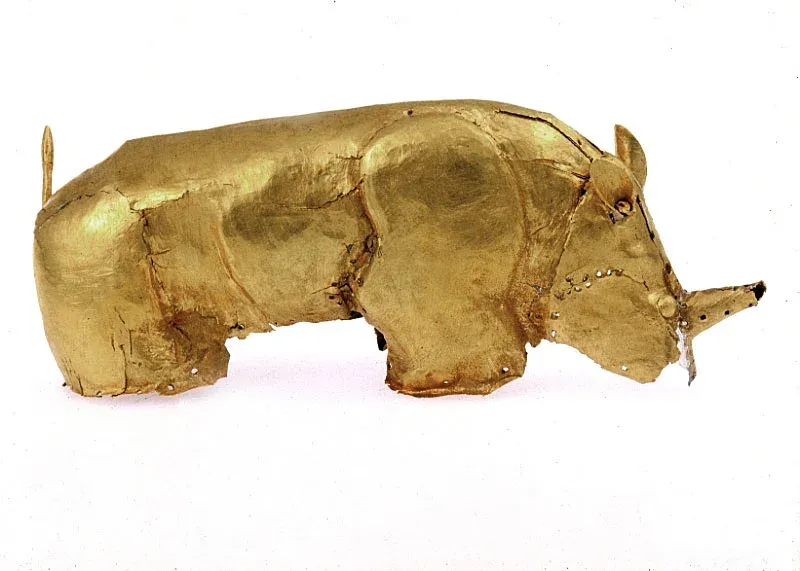
A rhinoceros of gold foil over a wooden core, eight centimetres long, from the royal burials of Mapungubwe: the symbol of southern Africa's first kingdom.
c. 1250Zoomable photographFamily viewing: Yes
Photograph: Sian Tiley-Nel · CC BY-SA 4.0 · Source
Held by: University of Pretoria Museums
The story
Mapungubwe, a flat topped hill on the Limpopo, was the capital of the first kingdom in southern Africa, rich on gold and ivory traded to the Swahili coast. On its summit the kings were buried with gold: sceptres, beads, a bowl, and animal figures of gold sheet tacked over carved wooden cores. The rhinoceros is the most complete: 8 centimetres of gold foil, its horn and ears up, found in pieces and rebuilt.
The site was dug in 1933-34 and then kept quiet for decades, because a rich, organised African kingdom of the thirteenth century did not fit the story the South Africa of that day told about itself. The gold is now the University of Pretoria's treasure and the rhinoceros the emblem of the Order of Mapungubwe, the country's highest honour.
The record, not the myth
The gold objects were reconstructed from crushed foil; the rhino's form is sound, its surface a conservator's rebuild. The kingdom's wealth is documented by the trade goods in its graves, glass beads from as far as Persia and China among them.
Sources
Image and model credits
- PhotographSian Tiley-Nel · CC BY-SA 4.0 · Source