
Artifacts · No. 70
Ife Head
A life size head in brass from Ife in Nigeria, cast with a naturalism that stunned Europe in 1910: proof, in metal, of a great African court art centuries before contact.
14th-15th centuryZoomable photographFamily viewing: YesCatalogue: Af1939,34.1
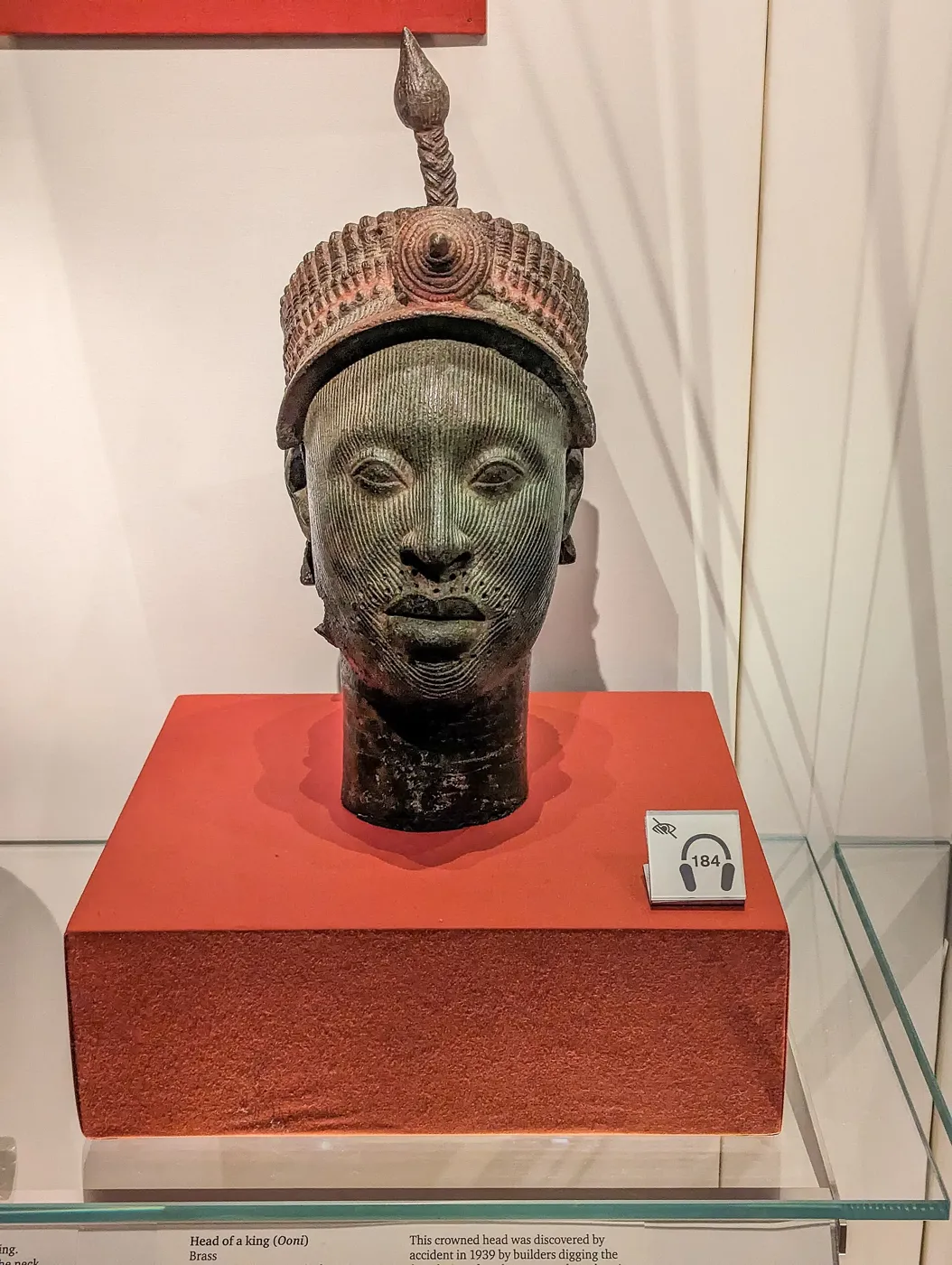
Photograph: Sourabh.biswas003 · CC BY-SA 4.0 · Source
Held by: British Museum, London · Catalogue Af1939,34.1
The story
In 1910 the German ethnographer Leo Frobenius dug at Ife, the holy city of the Yoruba, and found a head of this quality; he could not credit Africans with it and announced it must be Greek, a relic of Atlantis. The heads kept coming: in 1938 workers digging foundations at the Oni's palace turned up a cache of brass and copper heads, this among the finest, now in the British Museum. They are portraits, or ideal portraits, of the Ooni, the kings of Ife, cast by the lost wax method in the fourteenth and fifteenth centuries.
Analysis showed the metal is leaded brass, an alloy of copper and zinc with lead, not the bronze it is usually called. The striations on the face are scarification or a beaded veil, rendered line by line. Ife's heads stand with Benin's bronzes as the twin peaks of West African court art, and they were old when the Portuguese first reached the coast.
The record, not the myth
Bronze is the loose name; the alloy is leaded brass, and the museum's own analysis says so. Frobenius's Atlantis claim is kept in the object's story as a measure of what European scholarship of 1910 could not yet see.
Sources
Image and model credits
- PhotographSourabh.biswas003 · CC BY-SA 4.0 · Source