
Artifacts · No. 36
Galileo's Telescopes
Two plain tubes of wood, leather and glass that broke the old cosmos: the telescopes with which Galileo saw the Moon's mountains, Jupiter's moons and the phases of Venus.
1609-1610Zoomable photographFamily viewing: YesCatalogue: Inv. 2427 and 2428
Photograph: aiva. · CC BY 2.0 · Source
Held by: Museo Galileo, Florence · Catalogue Inv. 2427 and 2428
The story
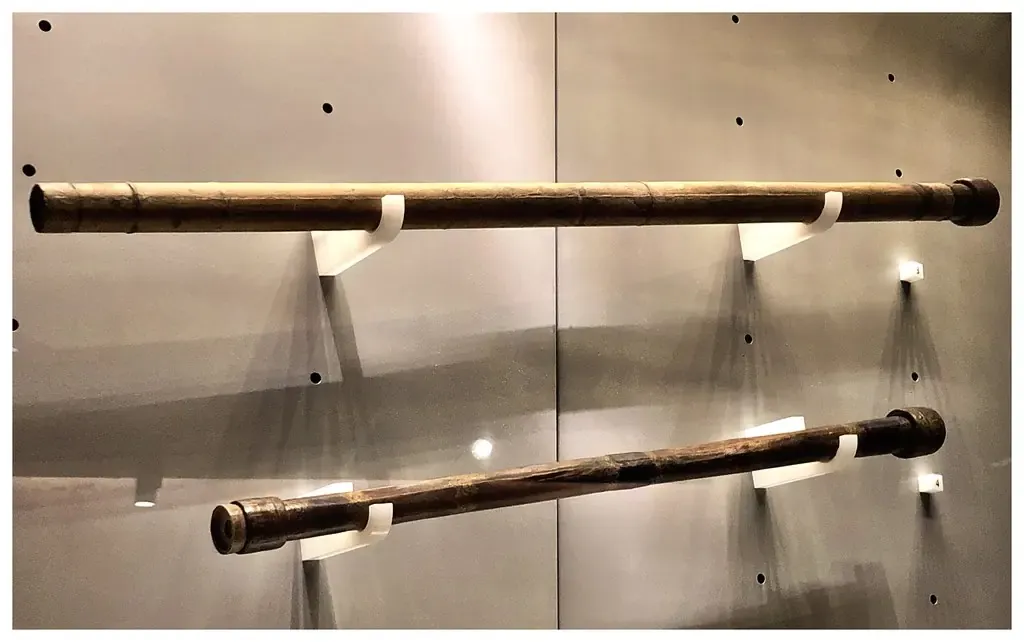
Hearing of the Dutch spyglass in 1609, Galileo ground his own lenses and pushed the magnification from three times to twenty and beyond. The two survivors in Florence are modest things: one a tube of wood covered in leather with a 37 millimetre objective, the other, its objective lens now broken and displayed in an ivory frame, the instrument traditionally tied to the Jupiter observations of January 1610.
What they showed is the point. In the Sidereus Nuncius of March 1610 Galileo published the Moon's rough face, the swarm of stars behind the Milky Way, and four moons circling Jupiter, proof that not everything in heaven circles the Earth. The Medici named the moons for themselves and made him court philosopher. The church fight came later; the tubes in Florence are where it started.
The record, not the myth
Galileo did not invent the telescope, and said so. Which observations were made with which surviving tube cannot be proven in detail; the museum presents them as his instruments on good but not airtight grounds.
Sources
Image and model credits
- Photographaiva. · CC BY 2.0 · Source