
Artifacts · No. 35
Behaim Globe (Erdapfel)
The oldest surviving terrestrial globe, finished in the year Columbus sailed: the world as Europe understood it on the eve of the discovery, with no Americas on it.
1492-1494Zoomable photographFamily viewing: YesCatalogue: WI1826
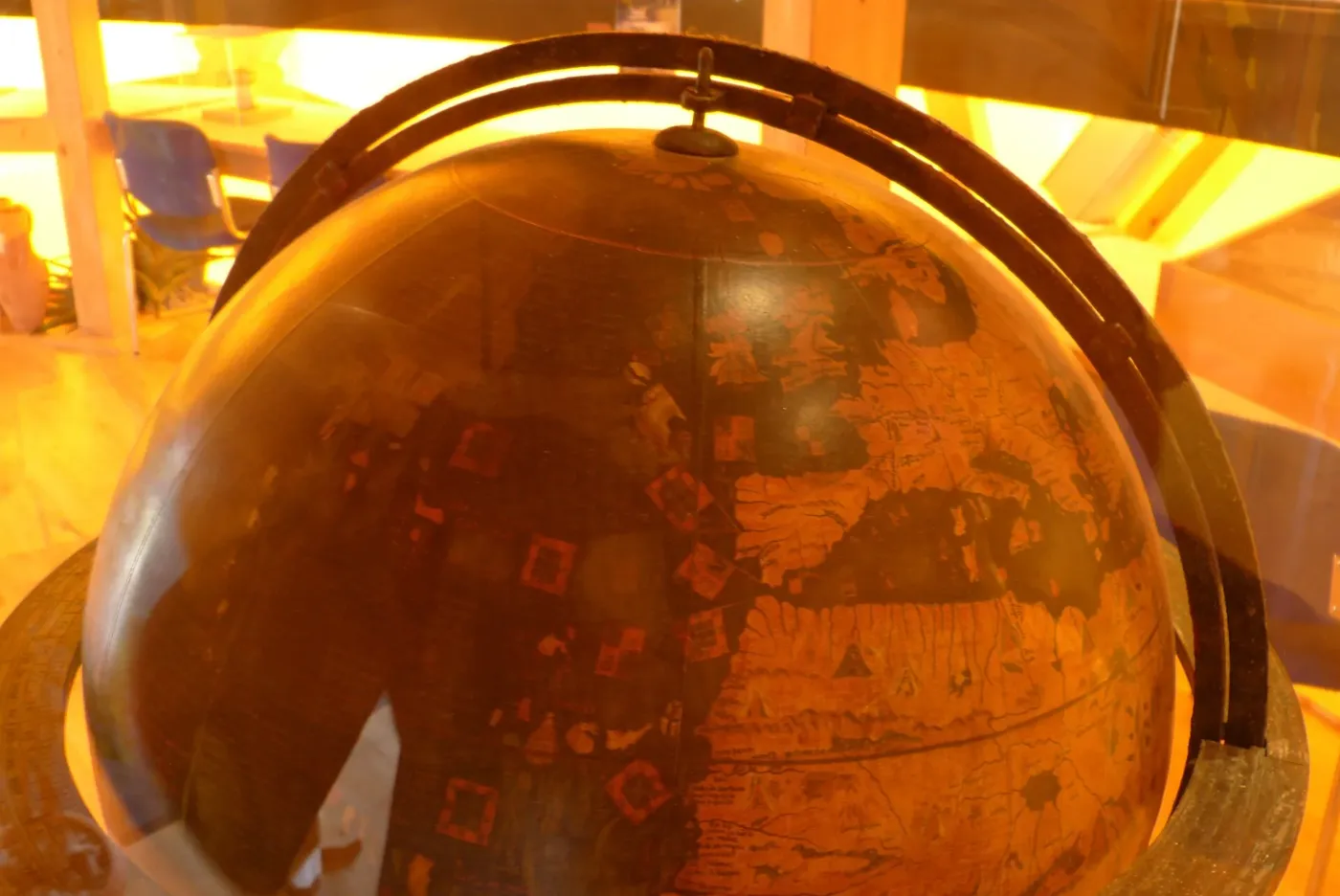
Photograph: Neitram · CC BY-SA 4.0 · Source · The museum's Globus1492 project publishes its own digital twin, linked below; this page carries a photograph.
Held by: Germanisches Nationalmuseum, Nuremberg · Catalogue WI1826
The museum's own scan. This object's published 3D scan is under a non commercial license, so it is not embedded here. Globus1492: the Behaim Globe digital twin (Germanisches Nationalmuseum)
The story
Martin Behaim, a Nuremberg merchant who had traded to Portugal and sailed the African coast, came home and persuaded the city council to fund a globe. Painters and craftsmen in Georg Glockenthon's workshop built it in 1492 to 1494: a ball of linen and parchment about 51 centimetres across, painted with the world of Ptolemy corrected by Marco Polo and the Portuguese voyages. The Atlantic is an island sea with Cipango, Japan, lying where Mexico should be, and the ocean crossing to Asia looks short. It was a persuasive object, and it was wrong in the most useful possible way.
The Erdapfel, the earth apple, is the Germanisches Nationalmuseum's treasure and has its own research portal, Globus1492, with a full digital twin. It never left Nuremberg for long: a working model of the world, made by the city that was then Europe's instrument making capital.
The record, not the myth
Behaim's claim to have sailed with Diogo Cão rests on his own telling and is doubted. The globe is a compilation of its sources' errors as much as their knowledge, which is exactly its value as evidence.
Sources
Image and model credits
- PhotographNeitram · CC BY-SA 4.0 · Source