
Artifacts · No. 14
Cyrus Cylinder
Cyrus the Great's own account of taking Babylon: a foundation barrel in Akkadian that became, in modern times, the most politically fought over object in the British Museum.
539 BCZoomable photographFamily viewing: YesCatalogue: BM 90920
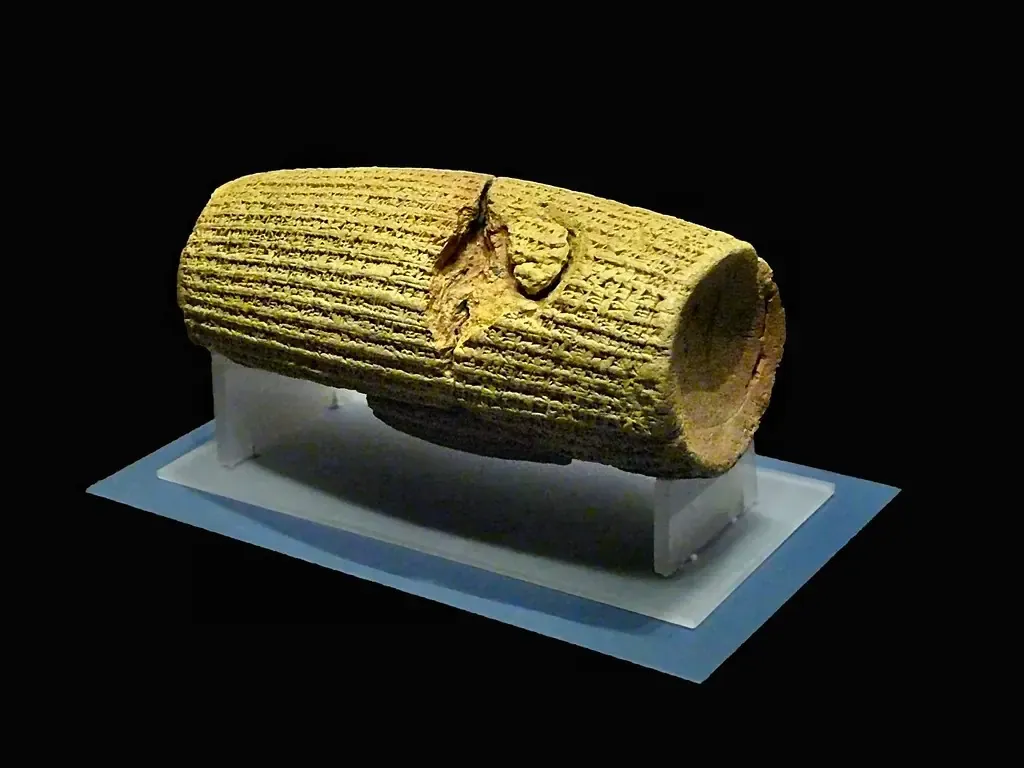
Photograph: dynamosquito · CC BY-SA 2.0 · Source
Held by: British Museum, London · Catalogue BM 90920
The story
After Cyrus of Persia took Babylon in 539 BC, his scribes wrote his version in Akkadian cuneiform on a clay barrel and buried it in the city's foundations, the standard place for a Mesopotamian royal proclamation. The text calls the last Babylonian king, Nabonidus, a failure who offended the gods, and Cyrus the chosen of Marduk, who entered the city without battle, returned stolen gods to their shrines and sent exiled peoples home with them.
Excavated in 1879, the cylinder sat in the British Museum as a fine example of a common text type until the twentieth century reframed it. Iran's monarchy promoted it as a first charter of human rights, it was lent to Tehran to enormous crowds, and a replica stands at the United Nations. The object has not changed; the argument around it has never stopped.
Cyrus speaks
“I am Cyrus, king of the world, great king, mighty king, king of Babylon, king of Sumer and Akkad, king of the four quarters of the earth.”
The opening of the cylinder's self presentation, after the lines denouncing Nabonidus. The return of exiles, including the Jews of Babylon, is described later in the text.
The record, not the myth
It is a royal foundation inscription in a standard Mesopotamian genre, not a rights charter in the modern sense: the human rights reading dates to the 1970s. Its policies, restoring cults and returning exiles, were also standard practice for a new king advertising legitimate rule.
Sources
Image and model credits
- Photographdynamosquito · CC BY-SA 2.0 · Source