
Artifacts · No. 15
Pilate Stone
The only contemporary inscription naming Pontius Pilate: a dedication block from Caesarea that fixes the gospel's Roman governor in stone, with his correct title.
AD 26-36Zoomable photographFamily viewing: Yes
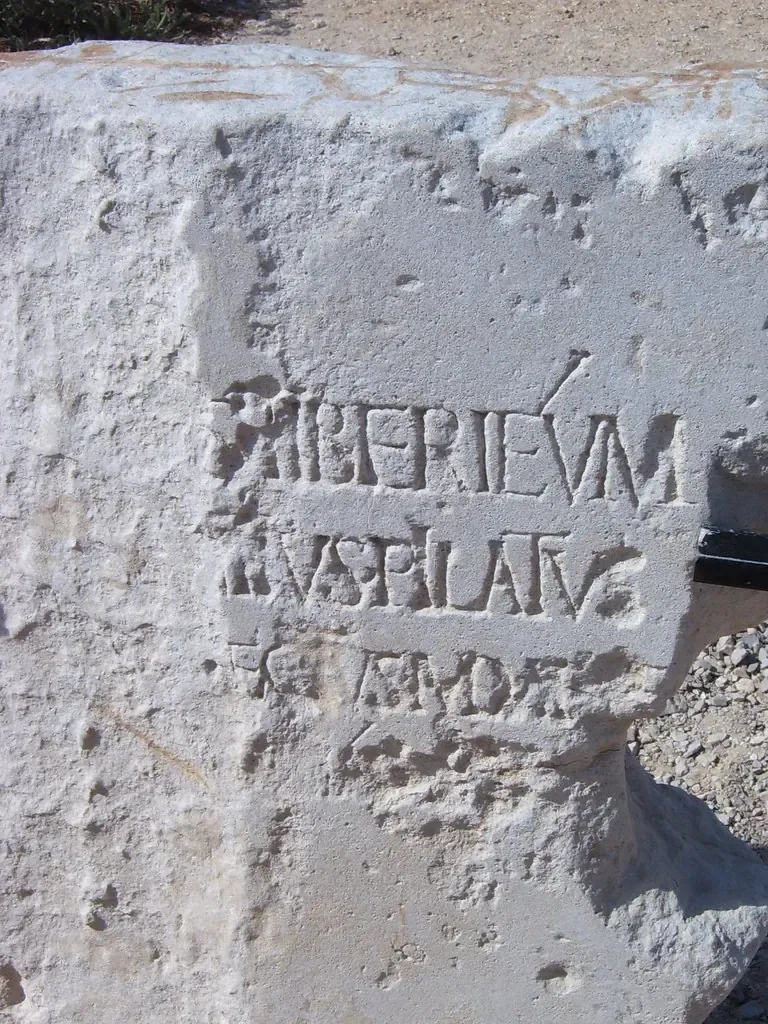
Photograph: heatkernel · CC BY 2.0 · Source
Held by: Israel Museum, Jerusalem
The story
In 1961 an Italian team digging the Roman theatre at Caesarea Maritima found a limestone block reused in a staircase, its face carrying a Latin dedication. Restored, it names a building, a Tiberieum, given to the people of Caesarea by Pontius Pilate, prefect of Judaea. The governor known from the gospels, Josephus, Philo and Tacitus had never been found in a contemporary inscription before; here he is, in the formal language of a dedication he paid for himself.
The stone settled a detail scholars had only from later writers: Pilate's title was prefect, not the procurator of later usage, which dates the inscription to his term, AD 26 to 36. The original is in the Israel Museum; a cast stands at Caesarea where the block was found.
The dedication, restored
[DIS AVGVSTI]S TIBERIÉVM [PONTI]VS PILATVS [PRAEF]ECTVS IVDA[EA]E [FECIT D]E[DICAVIT]
“To the divine Augustuses, this Tiberieum, Pontius Pilate, prefect of Judaea, made and dedicated.”
Brackets mark letters lost where the block was cut down for reuse as a stair tread.
The record, not the myth
The text is fragmentary and the reading of the first line, the name of the building, rests on the surviving letters. It confirms Pilate existed and governed; it says nothing about any trial.
Sources
Image and model credits
- Photographheatkernel · CC BY 2.0 · Source