
Artifacts · No. 20
Artemision Bronze (God from the Sea)
A life size bronze god, hurled up from a shipwreck off Cape Artemision: the finest surviving large bronze of the early classical age, caught mid throw.
c. 460 BCZoomable photographFamily viewing: NoCatalogue: X 15161
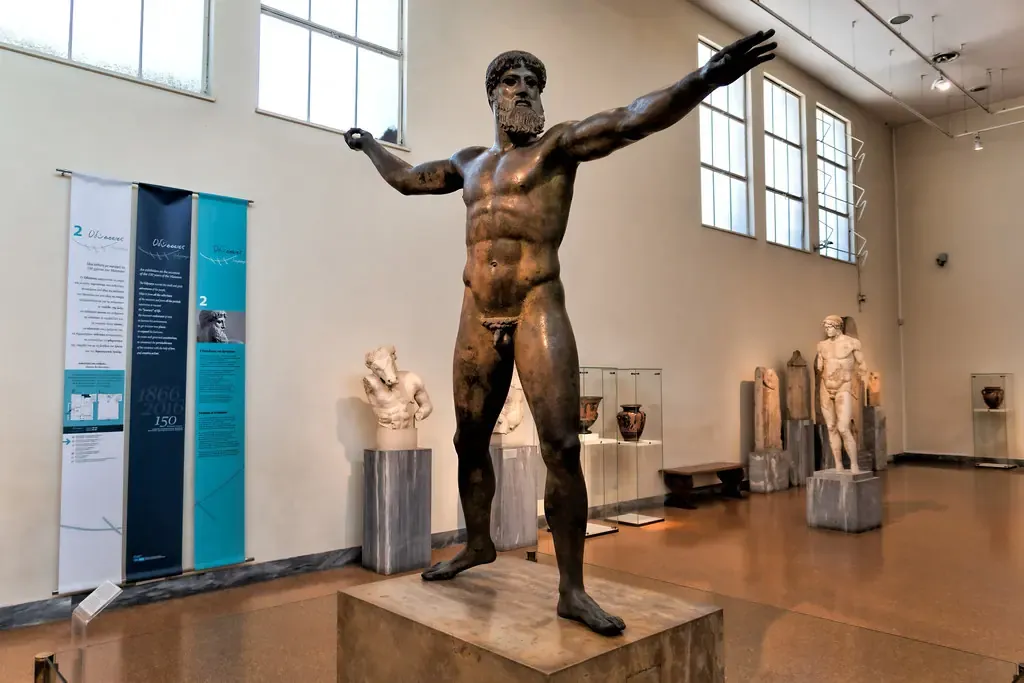
Photograph: Dan Lundberg · CC BY-SA 2.0 · Source
Held by: National Archaeological Museum, Athens · Catalogue X 15161
Seeing it. As of November 2026 the National Archaeological Museum is open. Its expansion's final designs were approved in October 2026; design work runs into 2027 and construction follows, with closure expected during the works.
The story
Fishermen dragged a bronze arm from the sea off Cape Artemision in 1926, and Greek divers went down to the wreck and brought up the whole figure in 1928: a naked god over two metres tall, bearded, his left arm levelled at a target and his right arm cocked back to throw. The eyes were inlaid, the lips and nipples copper. Nothing else of this size and quality survives from the years right after the Persian Wars, when bronze founders were casting the statues that Roman copies would later make famous.
What he throws is the argument. If a trident, he is Poseidon; if a thunderbolt, Zeus. The bolt or trident is lost with the wreck's unrecovered cargo, and the hand's grip has been measured both ways. The museum labels him Zeus or Poseidon, and the figure strides on in Athens either way.
The record, not the myth
The Zeus or Poseidon question is open and probably unanswerable from the surviving evidence. The wreck that carried him has never been fully excavated; where he was made, and where he was going, are unknown.
Sources
Image and model credits
- PhotographDan Lundberg · CC BY-SA 2.0 · Source