
October 6, 2026
Gustave Le Bon
On May 7, 1841, in Nogent-le-Rotrou, Eure-et-Loir, Charles-Marie Gustave Le Bon was born into a provincial French family. He took his medical doctorate at Paris in 1866, served as an army medical officer during the Franco-Prussian War of 1870–1871, and observed the violent rise and fall of the…
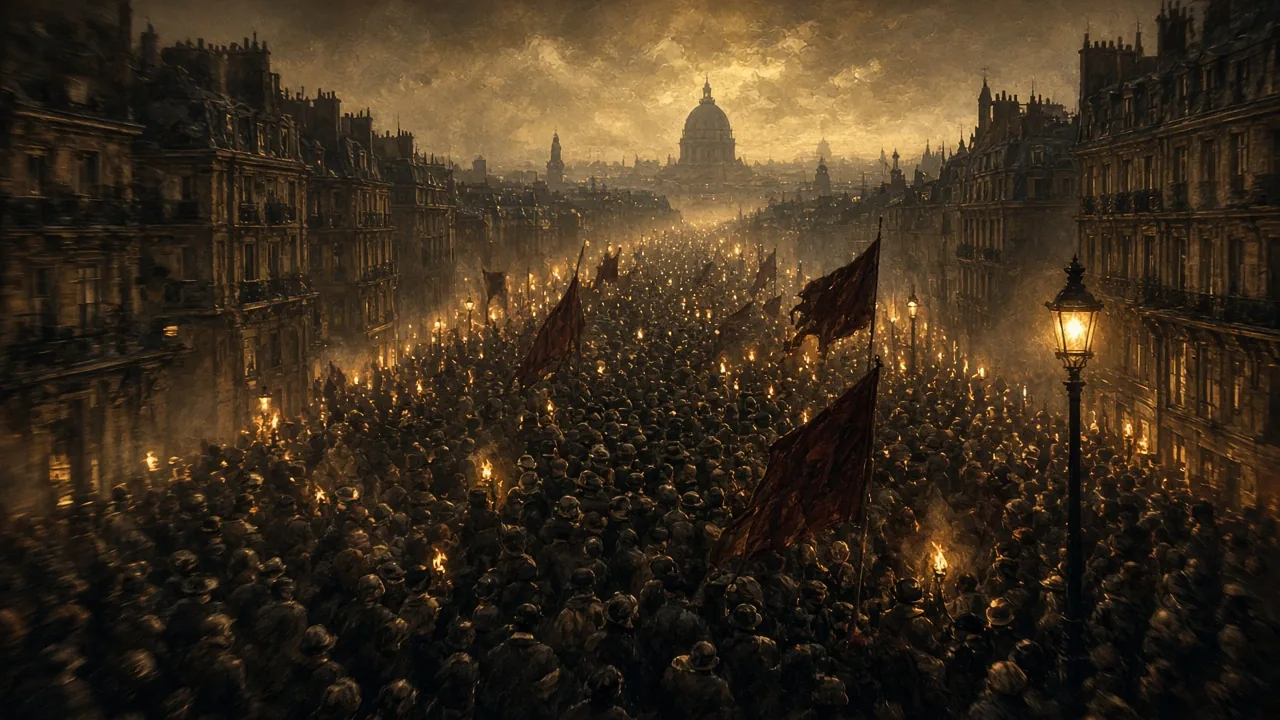
On May 7, 1841, in Nogent-le-Rotrou, Eure-et-Loir, Charles-Marie Gustave Le Bon was born into a provincial French family. He took his medical doctorate at Paris in 1866, served as an army medical officer during the Franco-Prussian War of 1870–1871, and observed the violent rise and fall of the Paris Commune in 1871, watching revolutionary crowds set fire to the Tuileries, the Hôtel de Ville, and the Louvre library. He never held a university chair or belonged to the academic establishment, yet from 1902 until his death he directed Flammarion's Bibliothèque de philosophie scientifique, overseeing a massive publishing empire that sold over two million copies across more than 220 titles. He died at his home in Marnes-la-Coquette on the night of December 13–14, 1931, at ninety years old. Over his long career as a physician, publicist, traveler, editor, and salon host, Le Bon developed a sweeping psychological system that sought to explain human history through the lens of racial inheritance, collective unconsciousness, and mass persuasion.
Le Bon’s intellectual trajectory began with physical anthropology and brain measurement. In 1879, he published a lengthy memoir in the Revue d'anthropologie on the variations of brain volume and their relation to intelligence, introducing a portable cephalometer he invented to measure cranial capacities during his travels. The memoir earned him the Godard Prize from the Société d'anthropologie de Paris. In this work, Le Bon asserted that cranial capacity directly tracked intelligence, explicitly arguing that many women possessed brains closer in size to gorillas than to civilized men, exhibiting an incapacity for logic, reflection, and reason. These claims were promptly dismantled within six years by anthropologist Léonce Manouvrier in the very journals of the Société d'anthropologie, who pointed out the vast number of unintelligent men whose brain weight exceeded that of highly intelligent women. Nevertheless, the premise of innate biological hierarchy remained the foundational core of Le Bon's worldview.
Commissioned by the French government in the 1870s and 1880s, Le Bon traveled extensively across North Africa, India, Arabia, and Nepal, publishing lavishly illustrated volumes such as La Civilisation des Arabes in 1884 and Voyage au Népal in 1886. He praised historical Arab achievements while dismissing Islam as a force of societal stagnation, and he became recognized as the first Frenchman to visit Nepal. In 1894, he synthesized his anthropological theories in Lois psychologiques de l'évolution des peuples (Psychological Laws of the Evolution of Peoples). In this foundational work, Le Bon classified human races into primitive, inferior, average, and superior categories, restricting the capacity for major scientific and artistic creation exclusively to Indo-European peoples. He asserted that a race constitutes a permanent entity governed primarily by its dead ancestors, whose accumulated psychological traits form an unchangeable racial soul. For Le Bon, character was an unalterable hereditary trait, rendering Enlightenment ideals of human equality fundamentally false.
In 1895, Le Bon published his most famous work, Psychologie des foules (The Crowd: A Study of the Popular Mind). He argued that a psychological crowd is not merely a physical gathering, but a state in which individual conscious personality vanishes and a temporary collective mind forms under the law of the mental unity of crowds. Le Bon identified three primary mechanisms driving this transformation: anonymity, which removes personal responsibility; contagion, which rapidly spreads emotions; and suggestibility, which he explicitly equated to hypnotic trance. Within a crowd, he claimed, the cultivated individual descends several rungs on the ladder of civilization, transforming into an impulsive, credulous barbarian guided entirely by instinct. He observed that crowds are image-led, incapable of rigorous reasoning, and exhibit marked feminine traits, remaining responsive to tyrants while despising weakness. To govern or manipulate a crowd, Le Bon outlined four core techniques: affirmation free of proof, constant repetition, emotional contagion, and the overwhelming influence of prestige. Crucially, he noted that crowds can just as easily perform acts of extreme martyrdom and heroism as acts of destruction, though he insisted that civilizations are created exclusively by a small intellectual aristocracy.
Le Bon turned these psychological tools against political movements in his 1898 book, Psychologie du socialisme (The Psychology of Socialism). He characterized socialism not as a valid economic theory, but as a secular religion propagating itself through sentiment, affirmations, and chimerical promises rather than logic or reason. He argued that socialism appeals to the low instincts of envy and hatred, offering an impossible equality of condition against unchangeable natural inequalities. Citing French election data from 1893, Le Bon emphasized that small property owners served as a stubborn conservative bulwark against socialist expansion. However, his analysis made a significant category error by flattening distinct political traditions—such as social democracy, Marxism, and mutualism—into a single psychological phenomenon driven purely by resentment.
During the 1890s and early 1900s, Le Bon attempted to establish himself in physical science, setting up a home laboratory where he claimed in 1896 to have discovered a new phenomenon termed "black light". Though it attracted serious attention in France and earned him a 1903 nomination for the Nobel Prize in Physics from Belgian physicist Albert de Heen, "black light" was entirely non-existent—a product of self-deception similar to N-rays. In his 1805 book L'Évolution de la matière, he wrote speculative passages on intra-atomic energy that readers later interpreted as an anticipation of mass-energy equivalence. When he wrote to Albert Einstein in 1922 seeking credit, Einstein politely replied that while mass-energy equivalence had been suggested before, only the theory of relativity provided a cogent proof. Despite lacking academic standing or scientific validation, Le Bon cultivated enormous social prestige through his weekly Wednesday luncheons (déjeuners du mercredi), hosting prominent figures including Henri Poincaré, Raymond Poincaré, Paul Valéry, Henri Bergson, Aristide Briand, and Marie Bonaparte.
Subsequent scientific inquiry falsified the majority of Le Bon's explanatory mechanisms. Modern crowd sociology and social-identity theory (such as the work of Postmes, Spears, and Stephen Reicher) have demonstrated that crowds do not shed all social norms or revert to hypnotic barbarism; rather, individuals shift from personal identity to shared group norms, engaging in meaningful collective action. Furthermore, historical and disaster research has disproved the myth that panic stampede is the default human behavior in crises, revealing that mutual aid remains common. His racial hierarchies, brain-volume theories, and characterizations of female intellectual inferiority have been completely repudiated by modern biology and anthropology. Conversely, his practical insights regarding political rhetoric—specifically the power of affirmation, repetition, prestige, and identity-driven narrative over logical argument—remain accurate descriptions of mass persuasion, political campaigns, and advertising.
The historical legacy and influence of Le Bon must be evaluated through a rigorous grading of evidence rather than historical folklore. In 1921, Sigmund Freud engaged directly with The Crowd in Group Psychology and the Analysis of the Ego, accepting its descriptive power regarding contagion and suggestion while reinterpreting the phenomenon through libido theory and explicitly noting that Italian criminologist Scipio Sighele had published key crowd theories prior to Le Bon. In 1928, Edward Bernays directly cited Le Bon and Trotter in Propaganda, using their concept of the group mind to formulate modern public relations techniques. Beyond these direct, primary-source connections, other claims remain secondary or unverified: Benito Mussolini's praise of Le Bon reaches us through secondary interviews, conceptual similarities in Adolf Hitler's writing lack direct textual proof of transmission, and claims that Vladimir Lenin kept The Crowd on his nightstand rest entirely on unverified memoir hearsay.
Ultimately, Gustave Le Bon captured a pivotal historic moment when political power moved toward mass publics, print media, and democratic institutions. He packaged elite fears of universal suffrage and social upheaval into a compelling manual of crowd psychology, binding valid observations on mass emotion to an erroneous racial metaphysics. His work remains a potent demonstration of how descriptive insights into human behavior can be deployed to serve political ends, proving that while his specific biological explanations failed, the broader dynamics of mass persuasion he described continue to shape the modern era.
Comments
Loading comments…