
Then and Now · W25
Trier, Augusta Treverorum
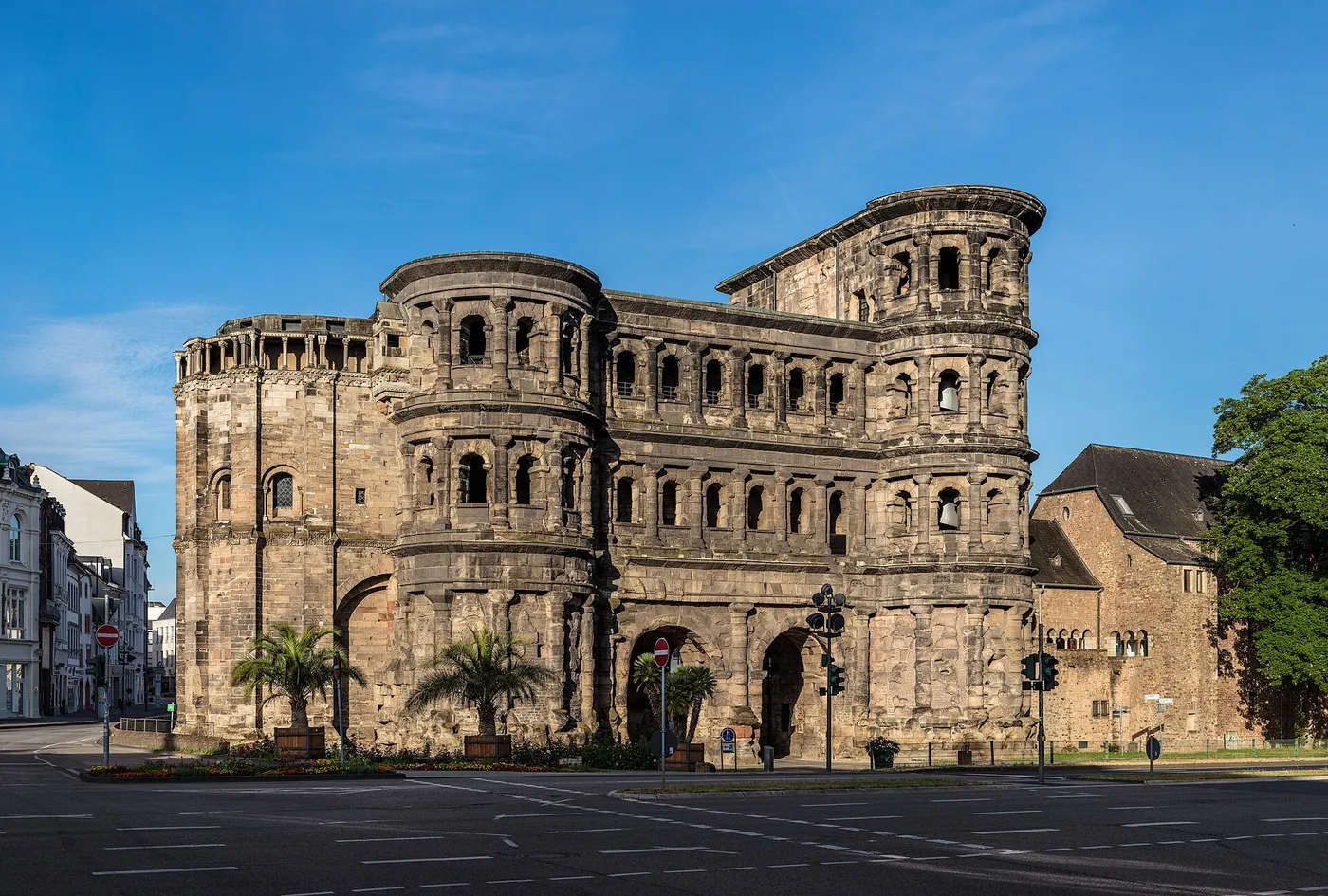
Ramboux drew the Porta Nigra in 1814, when the great Roman gate of Trier was still half a church, its towers filled with chapels and a hermit's cell. Napoleon had ordered the church stripped out; the photograph shows the gate as the order left it, standing free in the modern city.
Then: The Porta Nigra in 1814Historical imageFamily viewing: Yes
 ThenNow
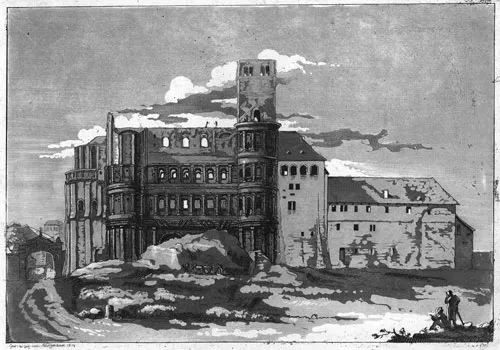
Then. The Porta Nigra in 1814. This is a real historical image of the place.
Now. A real photograph of the place as it stands.
Did you know? The gate survived because a Greek hermit, Simeon, walled himself into its east tower in the 1020s. After his death the archbishop turned the whole gate into a church in his honor, which kept the Roman stonework in use for 800 years.
Then and now
Trier was the greatest Roman city north of the Alps, an imperial residence with baths, an amphitheatre and a wall whose north gate, the Porta Nigra, was built about AD 170 from huge sandstone blocks held by iron clamps. Its name, the black gate, comes from the stone's weathering.
In the middle ages the gate became a double church, its Roman openings filled and floors inserted. Napoleon, who took Trier in the wars, ordered it restored to a Roman monument, and Prussia finished the work. Ramboux drew it mid transformation; the photograph shows it today, black stone and Roman arches, with trams passing where the legions marched in.
What changed. It survived as a church; Napoleon had the church removed; it stands free in a modern city.
The record, not the myth
The gate's black color is weathering on pale sandstone, not its Roman color; the builders knew a light colored gate, and the name Porta Nigra is medieval.