
Then and Now · E25
Baghdad, Round City of al-Mansur
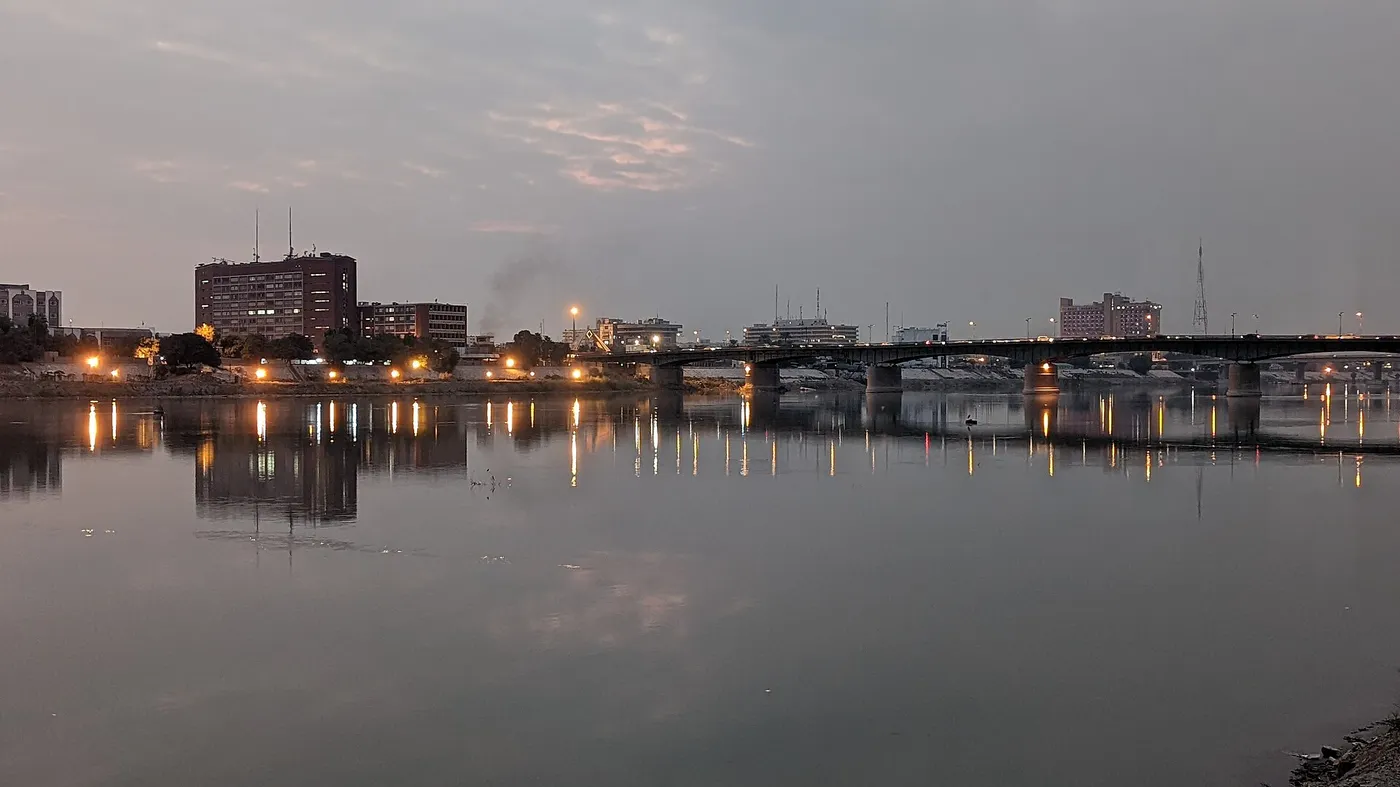
No image of the Round City survives, because nothing of it does: the reconstruction follows Guy Le Strange's plan of 1900 and the Arabic descriptions, a perfect circle of double walls with the caliph's palace and mosque at its center. The photograph shows the Tigris at Baghdad today. The circle lies under the modern city, unexcavated and unmarked.
Then: Founded AD 762AI reconstructionFamily viewing: Yes
 ThenNow
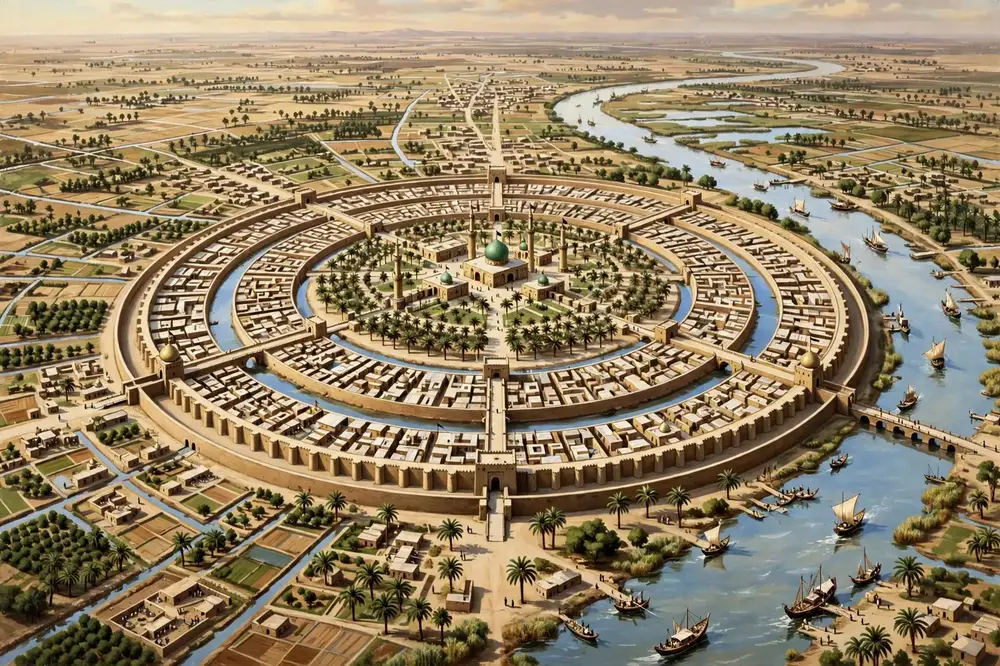
Then. Founded AD 762. This view is an AI reconstruction, built from the scholarship cited below. It is not a photograph.
Now. A real photograph of the place as it stands.
Did you know? Al-Mansur laid out the circle himself, by the texts: he had the plan traced in ash on the ground and walked it, then burned cotton seeds soaked in naphtha along the lines at night so he could see his city burning in outline before a wall was built.
Then and now
In 762 the Abbasid caliph al-Mansur founded his capital on the west bank of the Tigris as a perfect round city, about two kilometres across: double walls and a moat, four gates to the four quarters of his empire, and at the empty center the caliph's palace with its green dome and the congregational mosque, no one allowed to live beside him.
Baghdad outgrew the circle within a generation and became the largest city of its age on both banks of the river, until the Mongols sacked it in 1258. Of the Round City itself nothing stands and nothing has been excavated; its walls were robbed out and its ground built over centuries deep. The Tigris photograph shows the riverfront of the modern capital of five million plus, the circle somewhere beneath its western districts, its shape known only from texts.
What changed. No trace survives; the site was built over, and the city was sacked by the Mongols in 1258.
The record, not the myth
The circle and its dimensions come from texts, not excavation.