
Wednesday 11 November 2026
Tankers keep burning in Hormuz while Iran says the strait stays shut until Washington meets its seven conditions
Iran's security chief Mohsen Rezaei said on Tuesday that the Strait of Hormuz stays closed until the United States meets the seven conditions Tehran set out in the June interim agreement, and that there are no talks under way. The same day, Iran's Revolutionary Guards navy said two tankers had caught fire after hitting naval mines on an unauthorised route through the strait, and Britain's maritime agency reported another tanker struck off Oman. Thirty seven ships were attacked in and around the strait in October, the highest monthly total since the war began.
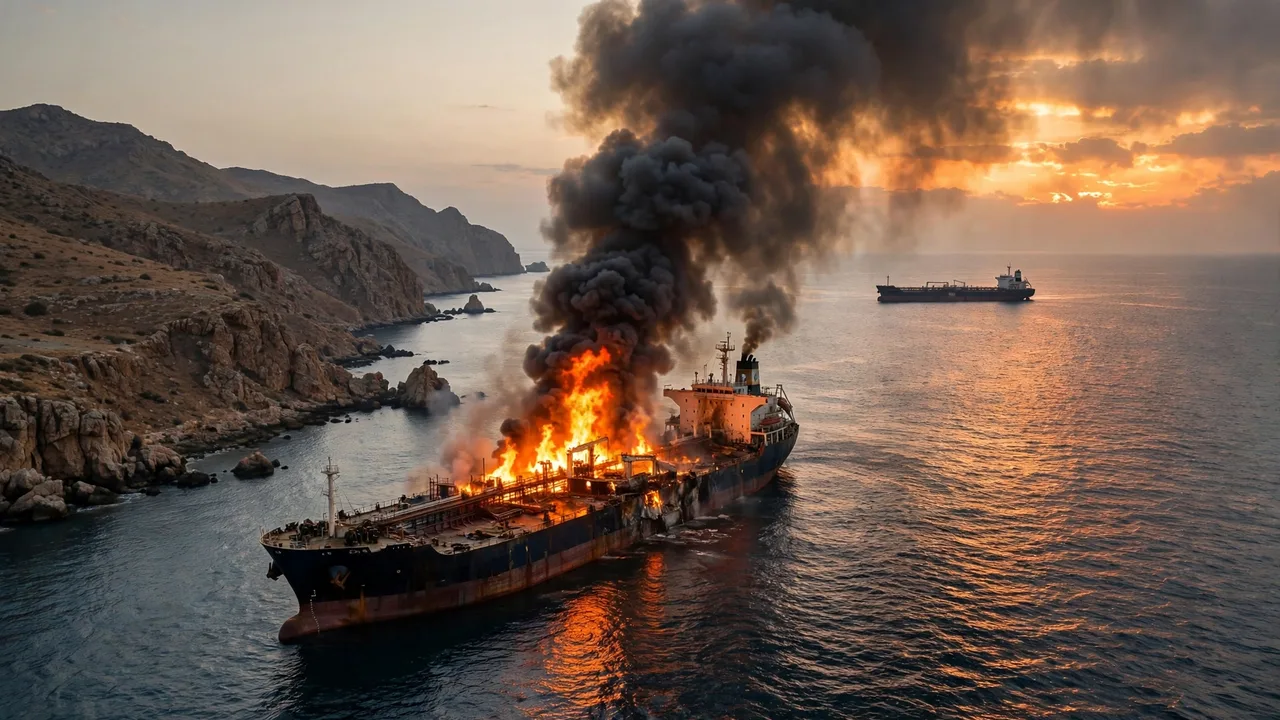
The strait is still a war zone, whatever the oil market wants to believe. On Tuesday, November 10, Iran's security chief Mohsen Rezaei told state television that the Strait of Hormuz will not reopen until the United States meets the seven conditions Iran laid out in the interim agreement the two sides reached in June, the details of which have not been made public. "At the moment, there are no talks," Rezaei said. "We are still waiting for a clear response from the United States to the seven conditions." Foreign Minister Abbas Araghchi has said the strait could reopen within two days once the conditions are met. The American naval blockade of Iranian ports remains in place.
While the diplomats traded statements, ships kept getting hit. The Revolutionary Guards navy said two tankers caught fire on Tuesday after striking naval mines on what it called an unauthorised route through the strait, and Iranian reporting later claimed a third. Britain's UK Maritime Trade Operations agency separately reported a tanker struck in an incident northeast of Lima, Oman, the same day. Reuters verified video of the Navig8 Messi, a Singapore flagged products tanker, burning near the Omani coast after it was hit on Sunday; Iran's state broadcaster said it was one of three tankers attacked that day for using unauthorised routes. The Revolutionary Guards have warned since the spring that only vessels using the route Iran designates may pass, and that ships on any other track risk mines and missiles.
The monthly count shows what that means in practice. The Washington Institute, tracking attacks in and around the strait, counted 37 ships attacked in October, the highest monthly total since the war began, and 10 more so far in November, as of November 11. The International Maritime Organization has confirmed about 130 incidents since late February, in which at least 25 seafarers have been killed. Oil still moves: flows through the strait have averaged about 10.5 million barrels a day since the start of October, according to Kpler, but freight and war risk insurance run at roughly ten times their level before the war.
Secretary of State Marco Rubio, in Paris on Tuesday, argued that the economic campaign against Iran is doing the work without major combat operations, and crude markets have been pricing in an easing war, which is why Brent fell to two month lows this week. On Wednesday morning it rose again, up 71 cents to 92.20 dollars a barrel, as the new tanker attacks offset the hopes of de-escalation. The gap between the market's hope and the Guards' mines is the whole story of the strait right now: the waterway reopens when Tehran's conditions are met or when someone clears it by force, and neither has happened.
Update, Wednesday, November 11: Reuters reported on Wednesday that Iran attacked the ship navigation systems on Didamar, an uninhabited Omani island in the strait, with three sources confirming the strike that Tehran's Revolutionary Guards had claimed on Tuesday. Reuters could not establish whether any navigation equipment was destroyed, and two shipping sources and a maritime security source told the agency the attack would likely have limited effect on commercial traffic. Gulf exporters have been working around the strait with ship to ship transfers off Oman and the United Arab Emirates, and exports recovered to more than 80 percent of their level before the war in September and October. Iran's parliament speaker and lead negotiator, Mohammad Bagher Ghalibaf, also set out Tehran's seven conditions in an interview published on Wednesday. They include lifting the American naval blockade and sanctions, releasing Iran's frozen funds and ending the fighting on all fronts. Ghalibaf said the strait will never return to its status before the war, and that Iran and Oman have reached an understanding to oversee the waterway together.
Update, Thursday, November 12: Two oil supertankers were disabled by massive explosions in the strait on Wednesday night after they ignored warnings against using an unauthorised route, Iran's Revolutionary Guards Navy said on Thursday, in a statement reported by Reuters. The statement gave no cause for the explosions. In the earlier months of the war the Guards said they had struck tankers directly. More recently they have reported vessels catching fire after hitting naval mines on the southern route they call unauthorised. In several cases the United Kingdom Maritime Trade Operations agency has said tankers in the strait were struck by unknown projectiles. Iran also denied that any talks with the United States are under way and rejected an American proposal to move its 60 percent enriched uranium to a third country, in reporting from November 11 and 12, and it repeated that the strait stays shut until Washington meets its seven conditions.
On Thursday, November 12, Iran's military raised its own count, saying explosions had hit four tankers in all after two more struck mines in the eastern strait on Thursday afternoon and caught fire. Reuters said it could not independently verify the Iranian account. President Trump said the same day that the United States does not need a deal with Iran and claimed American control of the strait, in BBC reporting. Ship trackers counted only six commercial crossings of the strait on November 12 as of late evening, against a pre crisis average of about 85 a day, and Brent crude stood at 96.13 dollars a barrel, up about 4 percent in 24 hours, as of November 12.
Spotted an error in this story? Email [email protected] and it will be checked against the sources.