
Tuesday 10 November 2026
America, Russia and Ukraine sit down in Abu Dhabi for the first peace talks since February
American, Russian and Ukrainian negotiators opened two days of talks in Abu Dhabi on Tuesday, the first trilateral round since February and the fourth the Trump administration has brokered. Steve Witkoff and Jared Kushner lead the American side, Rustem Umerov leads Ukraine's delegation and Vladimir Medinsky leads Russia's. European and NATO officials are in the capital for separate meetings after the Kremlin insisted the talks themselves stay three way. The agenda covers postwar security arrangements, de-escalation and humanitarian issues, and reports differ on whether a ceasefire is formally on the table.
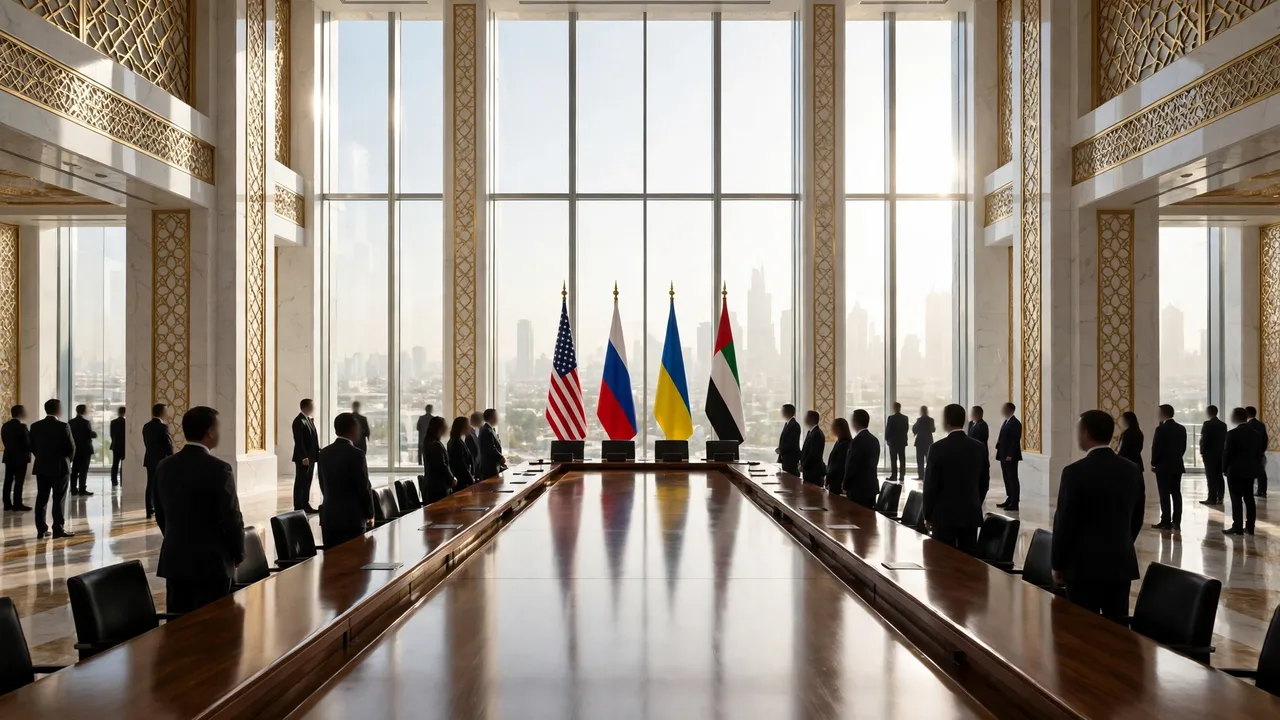
The delegations went into the room in Abu Dhabi on Tuesday morning with the war in its fifth year and no agreement on what the meeting is even for. The talks, set for Tuesday and Wednesday, November 10 and 11, are the fourth round of trilateral negotiations brokered by the Trump administration and the first since the round in Geneva this February. A round expected in March was postponed after the United States and Israel went to war with Iran.
The American side is led by envoy Steve Witkoff and Jared Kushner, the president's son in law. Ukraine's delegation is led by Rustem Umerov, the head of its foreign intelligence service and its top negotiator. Russia's is led again by Vladimir Medinsky, a hardline aide to President Vladimir Putin who has sat across from Ukraine in most rounds since March 2022. For the first time the Russian team also includes two deputy foreign ministers, Sergei Ryabkov and Mikhail Galuzin, along with military intelligence chief Igor Kostyukov and Yury Zhigarlovsky, a deputy head of the General Staff's operations directorate.
Witkoff set out the agenda when he announced the round: postwar security arrangements, de-escalation of the conflict and humanitarian issues. Kyiv wants more on the table. President Volodymyr Zelensky, speaking in Berlin on November 3, listed an energy ceasefire, an unblocking of the Black Sea, prisoner exchanges and preparation for a meeting of the three leaders. Accounts of the agenda still differ. Moldova's MOLDPRES agency reported that a ceasefire and territorial questions, above all Donbas, would be covered. The French newspaper Le Progres reported that a ceasefire is not on the agenda and judged the talks unlikely to produce one.
Europe is in Abu Dhabi but not at the table. Officials from the E4 group, Britain, France, Germany and Italy, and from NATO and the European Commission are in the capital and met the Ukrainian and American delegations before the trilateral session opened. France's foreign minister said on Sunday that European officials would turn up for the talks despite Kremlin objections. Kremlin spokesman Dmitry Peskov answered on Monday that the trilateral format had already been agreed, that Europe has its own channels with Kyiv and Washington, and that the session is a three way negotiation with the United States as mediator. Zelensky has said a lasting peace is not possible without Europe at the table. President Donald Trump suggested last week that a broad peace deal was possible and could incorporate Europe's security, and Washington has tied the Ukraine negotiation to a wider bargain on European security, a longstanding Russian demand that NATO allies have resisted before.
The fighting did not wait for the diplomats. At least 55 people were killed last Monday when Russia dropped bombs on a school building used as a shelter and aid centre in Zaporizhzhia, and the strikes on power and cities have continued through the autumn. Ukraine's General Staff said its forces struck the Morozov plant east of St Petersburg overnight into Monday and damaged three workshops. Russia struck at Ukraine's power network again in the same nights. The talks run through Wednesday, November 11. No statement announcing any agreement had come out of Abu Dhabi as of Tuesday morning, November 10.
Day one produced words, not agreements. The trilateral session ran nearly four hours on Tuesday, with a break of about 40 minutes in some accounts. President Zelensky, briefed by his team, called the format constructive and quite substantive, and said the delegations discussed the need and the possible terms of humanitarian steps, including prisoner exchanges and the return of Ukrainian civilians and children held in Russia, and the substance of security guarantees that could block any recurrence of the war over the long term. Secretary of State Marco Rubio, at the G7 meeting in Paris, said the first day looked very productive and urged patience, adding that the work is nowhere near finished in the next 24 hours. A senior Ukrainian official said the two sides talked about a large scale prisoner swap, with the details to be settled in the coming days.
The split that opened the talks is still the split. Foreign Minister Sergey Lavrov said after the session that Russia will not accept an immediate ceasefire without knowing what comes after it: in Moscow's order of business, the outlines of a future European security arrangement come first and a halt to the fighting second. Kyiv and the European Commission hold the reverse order, that talk of Europe's security architecture means nothing until a ceasefire exists. Territory did not move either: Moscow wants Ukraine out of the parts of Donetsk, Luhansk, Zaporizhzhia and Kherson it claims, and Kyiv proposes freezing the line where the armies stand. The fighting went on through the talks. Ukraine's air force said Russia launched 162 drones and a ballistic missile overnight, and Ukrainian officials said strikes on electrical substations in at least five regions killed two people in the Vinnytsia region and cut power across six regions, including Kyiv and Kharkiv. The second day of talks is Wednesday, November 11.
Update, November 11: The Abu Dhabi round closed on Wednesday with one agreed product. After the trilateral session, the United States, Russian and Ukrainian delegations met the European partners separately, and Ukrainian and Russian officials said the sides had committed in principle to a large scale exchange of prisoners of war in the near future, to be facilitated by the International Committee of the Red Cross, with the numbers and the timing left to a follow on technical session. That closing detail rests on thinner sourcing than the rest of the round: it comes from Ukrainian and Russian officials as reported by Interfax Ukraine and Ukrainska Pravda, and neither Washington nor the Red Cross had confirmed the terms as of Wednesday evening. Zelensky said American officials would travel to Russia to pursue the exchange.
Nothing else moved. No ceasefire was agreed, and Foreign Minister Lavrov, speaking on the margins, again rejected the European demand that a ceasefire framework come before a settlement. Territory was not discussed in substance, and no date was announced for another round. The fighting the talks were meant to stop continued underneath them: Ukrainian officials reported Russian strikes on six power substations across four central regions overnight, and on railway infrastructure, as the delegations sat down for the second day.
Update, Wednesday evening, November 11: The closing account firmed up during Wednesday. Both delegation heads, Vladimir Medinsky for Russia and Rustem Umerov for Ukraine, confirmed the prisoner exchange agreement in their own names, and Jared Kushner called it the biggest humanitarian release of prisoners of the war, with the numbers to be finalised on Thursday, November 12. Russia's state agency TASS reported that the exchange should happen in two to three weeks. Kushner described the talks as very substantive and pretty tough, and said he and Steve Witkoff will meet President Vladimir Putin in Moscow on Thursday and then travel to Dublin to meet President Volodymyr Zelenskyy. No joint statement was issued at the close, and no date for a further round was announced.
Spotted an error in this story? Email [email protected] and it will be checked against the sources.