
Monday 9 November 2026
The Krakow gunman dies in hospital, and Poland is left with nine deaths and no one left to question
The 24 year old who killed six people in Krakow's Main Market Square on Saturday died in hospital early on Monday, Polish police said, Reuters reported. Prosecutors say he also killed his father, his mother and his sister at the family home in Ostrowiec Swietokrzyski before he drove to Krakow. Poland's National Prosecutor's Office is treating the square shooting as a suspected terrorist offence, and the interior minister said the man held radical ultranationalist views. Fifteen people who were wounded in the square remain in hospital, one police officer in serious condition. On Monday evening thousands of people took part in a silent march through the city, and President Karol Nawrocki and Prime Minister Donald Tusk lit candles together at the square.
The man Poland needed to question most died before prosecutors could ask him anything. Police in the Malopolska region announced early on Monday that the 24 year old who opened fire in Krakow's Main Market Square on Saturday had died in hospital. The governor of the region, Krzysztof Kleczar, put the time of death at about 4:30 in the morning on November 9. The man had been shot by officers minutes into the attack and had gone through several operations.
Polish media have named him as Michal O., from Ostrowiec Swietokrzyski, a town of just under 60,000 people in southeastern Poland. Shortly after 3 in the afternoon on Saturday he drove into the Main Market Square, one of the busiest public spaces in the country, and fired at people from his car, through the windscreen as well as out of it. Police pursued him as he left the square and stopped him about two minutes later near the junction of Dietla and Stradomska streets, where he exchanged fire with officers and was wounded. Two officers were hurt in that exchange. Six people died in the square, four women and two men. Four of the dead were Polish citizens, one was a British man and one was an Austrian woman. A tram passing through the city centre was also hit by gunfire near Plac Wszystkich Swietych. The window of the driver's cab shattered and nobody on board was hurt.
On Saturday evening police found three more bodies at the family flat in Ostrowiec Swietokrzyski, about 150 kilometres northeast of Krakow. The dead were the gunman's father, aged 53, his mother, aged 52, and his sister, aged 21, and each of them had been shot, according to Daniel Prokopowicz, the spokesman for the district prosecutor's office in Kielce. Prosecutors believe the same man killed them on Saturday before he drove to Krakow, although the exact times have not been established. Autopsies on all nine victims were scheduled to begin on Monday and were expected to take about two days. The total number of people he is suspected of killing stands at nine, as of November 9.
The legal frame is terrorism. The National Prosecutor's Office classified the square attack as a suspected terrorist offence on Sunday, and Prime Minister Donald Tusk has called it an act of terrorism. Interior Minister Marcin Kierwinski said the suspect held radical ultranationalist views and appeared fascinated by far right ideologies. An interior ministry spokeswoman, Karolina Galecka, told radio TOK FM on Monday that the man had many emblems on his clothing, that specialists are examining the patches, and that the motifs are associated with various themes she would not spell out while the investigation runs. Justice Minister Waldemar Zurek said on Monday that the investigation will continue despite the death, to establish whether the gunman acted alone or was inspired by any group. Prosecutor Eryk Stasielak said the proceedings against the dead man himself will be discontinued, and that investigators will work from forensic examinations, witness testimony, his phone, his electronic storage, his handwritten notes and the material taken in searches. No letter explaining the attack was found on him or in his car.
The weapons were legal, and that fact is now part of the argument in Poland. Police recovered 11 firearms from places connected to the shootings, seven of them at the family property, and prosecutors said the number matches the permits held by the suspect and his father. Michal O. held a valid firearms licence, had no criminal convictions and was not known to police before Saturday. Some of the guns in his Subaru were within reach of the driver's seat and others were in the boot.
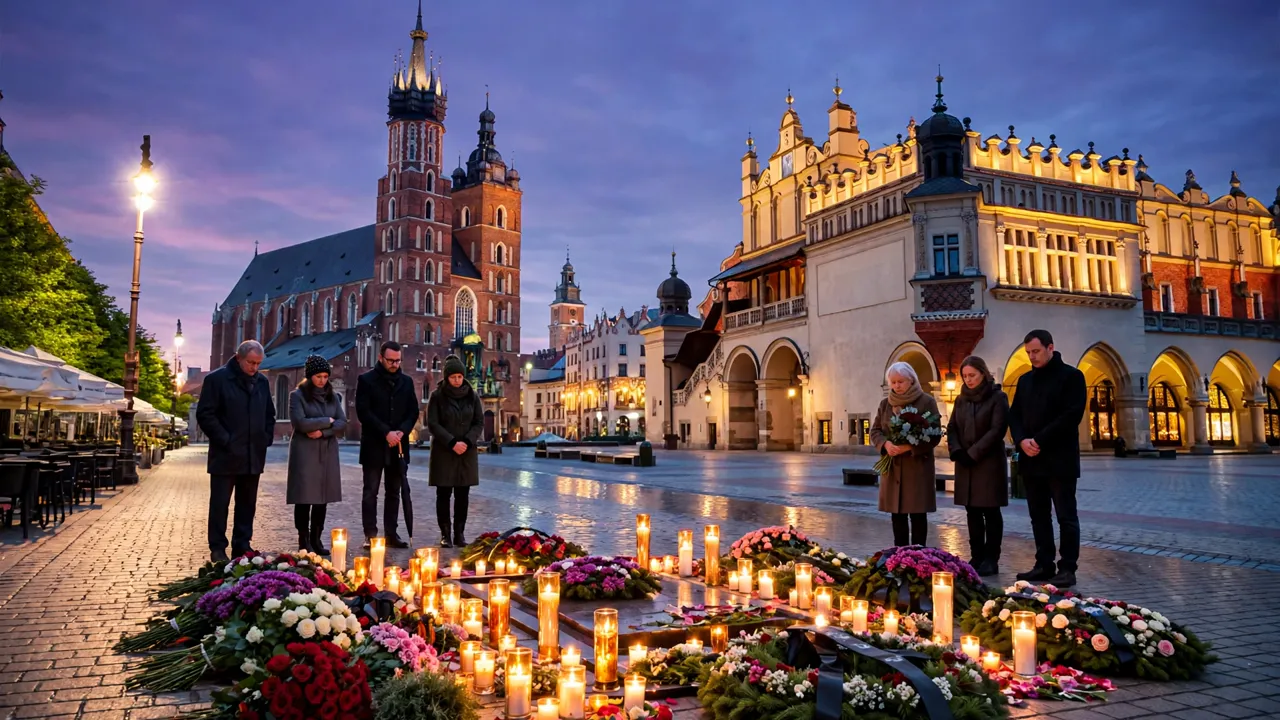
Poland spent Sunday and Monday in two days of national mourning. People laid flowers and candles at the edge of the square while police kept examining the route the car took. Fifteen wounded people remain in hospitals, 14 of them in stable condition and one police officer in serious condition, as of Monday. The country is asking how a licensed gun owner with no record came to kill his family and then strangers in its most famous square, and the one person who could have answered is dead.
Monday evening brought the country into the street. Thousands of people took part in a silent march through Krakow, following part of the route the gunman drove while firing and lighting memorial candles at the spots where people were killed. Mayor Lukasz Gibala had invited the public to the march of silence, which set off at 8 in the evening from the corner of the Main Market Square and Slawkowska Street. President Karol Nawrocki and Prime Minister Donald Tusk, bitter political rivals, arrived together, held candles side by side and knelt at the memorial. "Tonight in Cracow thousands of Poles gathered to pay tribute to the victims of November 7 attack," Tusk wrote afterward. "May they rest in peace." There were no speeches. Monday was the last day of the two days of national mourning, and Krakow keeps its own mourning through Wednesday, November 11, with flags at half mast.
The attack produced a second fight, over what was true. Digital Affairs Minister Krzysztof Gawkowski said false claims began appearing within minutes of the shooting, and that more than 2,000 accounts were reported for blocking or moderation in the first 24 hours, with posts carrying fake claims and conspiracy theories reaching as many as 200 million views. The claims included that the Polish government staged the attack with European Union involvement, that the gunman was a soldier, which the defence minister has said he never was, and that he was linked to Ukraine as a mercenary. Fact checkers at DW examined the viral pictures said to show the attacker and found them AI generated or altered, including a fabricated Telegram profile built after the attack. Officials have not attributed the whole campaign to any one state. Gawkowski said the dozens of flagged profiles that used the Russian language or referred to Russia demand special attention, without proving who ran the operation. Poland marks Independence Day on Wednesday, November 11, and Krakow keeps its mourning through that day.
Spotted an error in this story? Email [email protected] and it will be checked against the sources.