
Saturday 7 November 2026
The bomb threat campaign reaches Europe's newsrooms: 18 more flights disrupted on Friday, and threats land at Irish and Bulgarian broadcasters
A fresh wave of hoax bomb threats disrupted at least 18 flights across Europe on Friday and reached news organizations in Ireland and Bulgaria, The Guardian reported. The disrupted flights were to or from Bulgaria, Cyprus, Czechia, France, Hungary, Italy, Portugal and Romania and the United Kingdom, and nine of them involved Prague. Every aircraft landed safely and searches found no explosive device, as they have all week: threats on Tuesday and Thursday had already forced at least 35 flights to be diverted or searched. Ireland's government called the wider pattern likely a coordinated campaign of disruption. Investigators say they have no evidence so far that a terrorist group or a state directed the hoaxes.
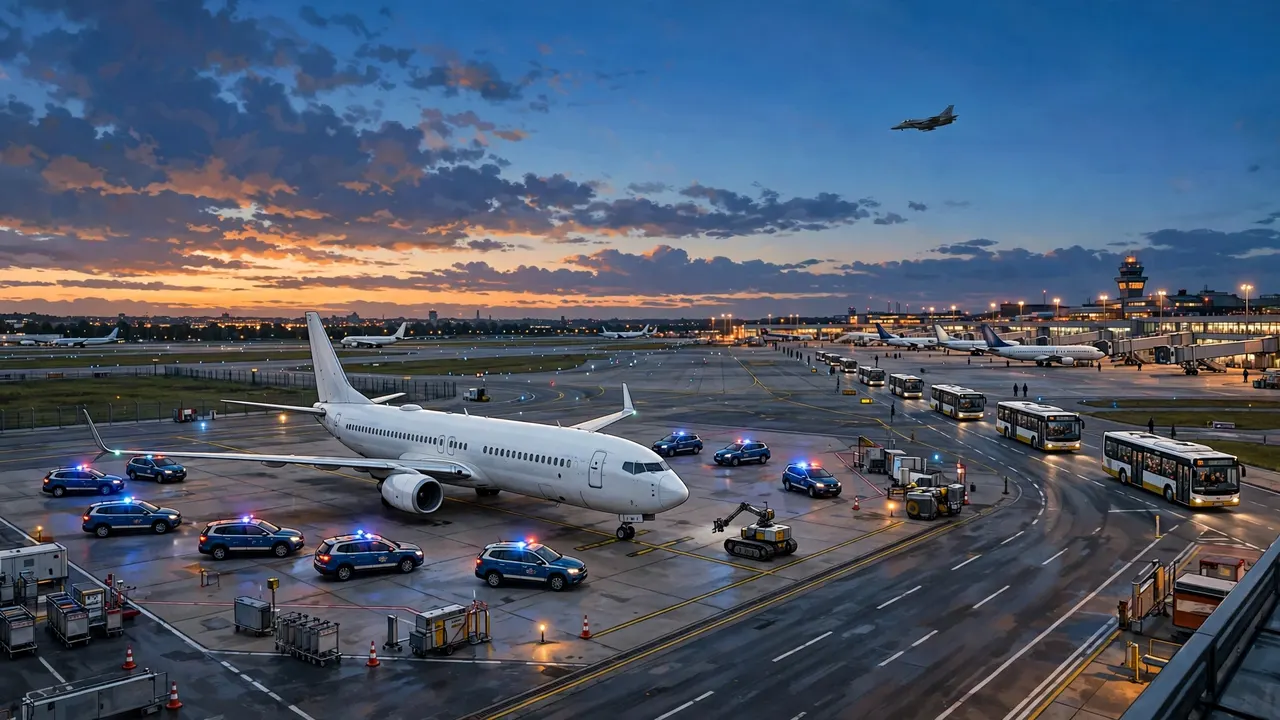
The hoaxes that have chased European aviation all week widened on Friday, from airplanes to the newsrooms that cover them. The Guardian counted at least 18 flights disrupted by bomb threats on Friday, to or from Bulgaria, Cyprus, Czechia, France, Hungary, Italy, Portugal, Romania and the United Kingdom. Nine of the flights involved Prague. A Wizz Air flight from Prague to Rome diverted to Venice, where passengers were evacuated after landing. Hungary's defence minister, Romulusz Ruszin-Szendi, said fighter jets were scrambled three times to escort civilian aircraft through Hungarian airspace. Danish police investigated a threat against Copenhagen Airport, where operations continued normally. The European transport commissioner, Apostolos Tzitzikostas, separately counted 11 further threats against flights reported on Friday. His figure counts reported threats and the Guardian's counts disrupted flights, so the two numbers measure different things and are reported here as their makers gave them.
The disrupted flights were a tiny share of the day's traffic, about 0.07 percent of the 26,709 flights Eurocontrol expected over Europe on Friday. The week's running total is larger: threats on Tuesday and Thursday forced at least 35 flights to be diverted or searched, which puts the week's disrupted flights above 50. No device has been found on any aircraft, and no one has been injured.
On Friday the threats reached the media. Irish broadcasters and publishers, RTÉ, Virgin Media, Newstalk, Bauer Media and Mediahuis among them, received bomb threats, a day after RTÉ was evacuated, and Bulgaria's Nova TV received a similar threat. Britain's Sky responded to a threat as well. Reuters reported that the emails to RTÉ and Nova TV came from a purported sender named Mikhail Andropov under the title "Message to the West," and that one message read, "This is only the beginning." Reuters said it could not verify the sender's identity, the origin of the emails or any connection between them and the threats against aircraft. Some of Thursday's threats were signed with the name of Vladislav Pozdniakov, a Russian extremist, who has denied being behind them.
Ireland's government said the threats against Irish media were likely a coordinated campaign of disruption, which is an official assessment, not a confirmed finding of who is responsible. Investigators across several countries say they have found no evidence so far that a terrorist organization or a state such as Russia or Iran is directing the hoaxes, and inquiries are continuing. Tzitzikostas said aviation security experts will meet in Brussels next week to discuss the response. The timing adds pressure: Dublin hosts the European Political Community and EU leaders' summits next Thursday and Friday, with about 50 heads of state and government expected in the city whose broadcasters were threatened on Friday.
The Friday emails to newsrooms carried the subject line "A Message to the West," warned of an explosion in 45 minutes and used the name Mikhail Andropov. Sky in Britain was among the roughly 50 European media outlets that received one. Russia has denied involvement, and European officials who are investigating a possible Russian origin say the attribution is not confirmed. No new wave of threats and no arrests had been reported as of Saturday.
Saturday update: The Times reported that Irish security sources believe Russia's intelligence services were behind the threats to Irish media and the more than 50 passenger flights threatened across Europe, and that the email to RTE came from someone using the name Mikhail Andropov, claiming a new wave of attacks was being prepared. Ireland's defence minister, Helen McEntee, said on Saturday that it was hard to tell at this early stage who was to blame, but that Russia could not be ruled out. Taoiseach Micheál Martin said on Friday that it was too early to establish whether Russia was behind the incidents, while acknowledging a general view that the escalation of hybrid attacks in recent months had a Russian dimension. Separately, reporting based on the Financial Times said the pro Russian hacking group NoName057(16) had put a bounty on the personal data of 18 people investigating the campaign, including the heads of Eurojust and Europol.
Sunday update: the Paris prosecutor has opened a formal investigation into the threat campaign, including whether a foreign power was behind the emails, Agence France-Presse reported. The European transport commissioner said it is too early to conclude whether the incidents are linked. No explosives have been found in any of the cases, and the senders have not been identified, as of Sunday.No European government has made a formal attribution, and Russia has denied involvement.
Spotted an error in this story? Email [email protected] and it will be checked against the sources.