
Saturday 7 November 2026
France's fourth protest Saturday falls to 146,000 nationwide with 360 arrests, and the movement looks to Lecornu's Monday conference
France's fourth Saturday of cost of living protests shrank again. The Interior Ministry put the national turnout at 146,000, against the organizers' count of 250,000, with 46,000 in Paris, and said 360 people had been arrested nationwide by 7 p.m. The Saturday count has fallen every week since October 17: 550,000, then 410,000, then 320,000, now 146,000, as of November 7. At Place de la Concorde about 100 people defied the ban on the Yellow Vests gathering and two of the movement's leaders were arrested. Prime Minister Sebastien Lecornu meets the unions and employers on Monday, and education unions have called a strike day for Tuesday, November 10.
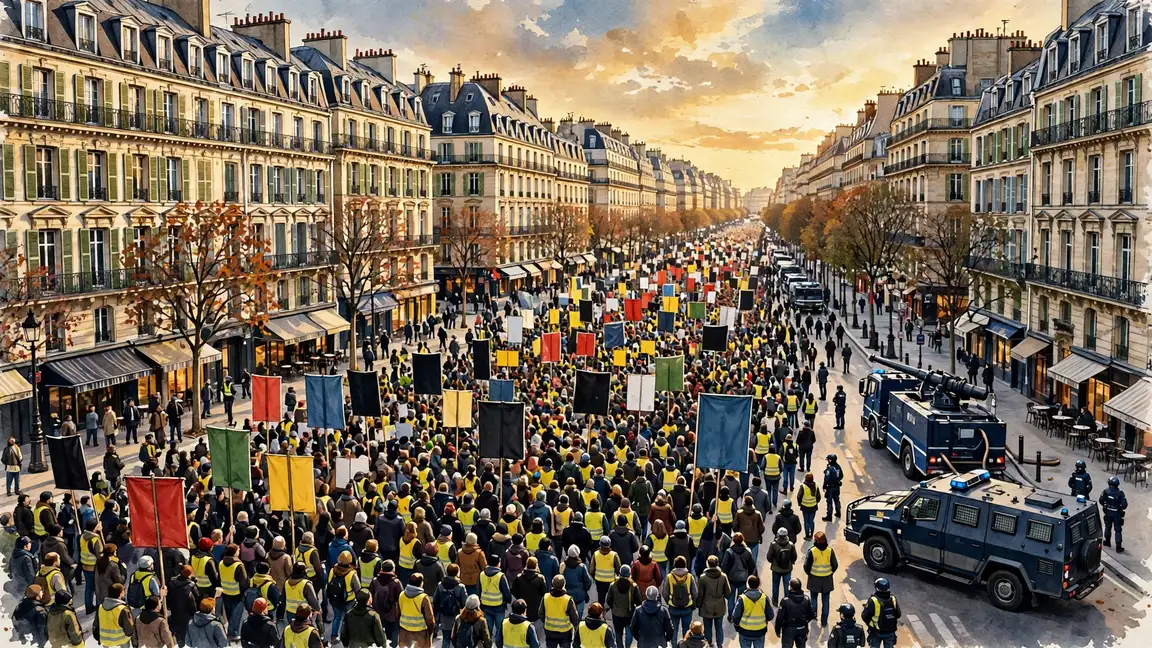
France's autumn of protests reached its fourth act on Saturday, on two tracks in the same city. The inter-union coalition marched in Paris on the route the police prefecture approved, from Place de la République to Place de la Nation, the same route the unions walked on Thursday, under the slogan "against the high cost of living and in support of young people." The Yellow Vests coordination called its own gathering, Act IV, at Place de la Concorde, next to the National Assembly and near the Élysée Palace. The prefecture banned that gathering. The coordination kept the call in place. "We are calling for mass disobedience," said Benjamin Ball, a member of its coordinating committee. The prefecture asked the Yellow Vests to join the authorized march instead. They refused. Fourteen Paris metro stations were closed for the day at the prefecture's request.
Interior Minister Laurent Nuñez kept the security deployment at Thursday's level: 70,000 police and gendarmes across the country, 25 Centaure armored vehicles, 15 water cannon, drones and helicopters. The Yellow Vests' own map listed about 120 actions in roughly 100 cities. BFMTV reported that 40,000 to 60,000 demonstrators were expected in Paris. No transport strike was announced for Saturday. The morning's first reports were small and peaceful: in Saint-Nazaire, 200 to 300 people gathered at La Soucoupe and marched from about 11:20 a.m. behind the Urgence sociale collective and the CGT, over the cost of living, wages and housing.
The demands are the ones the movement has carried since September, when students began protesting over school conditions. The CGT wants the minimum wage raised 10 percent at once. The minimum wage has had no discretionary increase since 2012, a point the unions make in every statement. The federations oppose the draft 2027 budget and its 43 billion euros in planned savings, and they want across the board pay rises, tax changes and better conditions for students. Thursday's marches were the largest of the autumn on the government's own count, nearly 600,000 people, against the CGT's count of almost 1.6 million.
The government has already given the movement its first meeting. Prime Minister Sébastien Lecornu will sit down with union leaders and employers at Matignon on Monday, November 9, for emergency talks on wages and purchasing power, and he has told his labor minister to finish the groundwork by Sunday. The talks come less than six months before a presidential election that President Emmanuel Macron cannot contest, with far right parties leading in the polls. What Saturday decides is the pressure each side carries into that room: the size of the authorized march, and whether the banned gathering at Concorde stays a gesture or becomes a confrontation in front of the National Assembly.
By Saturday afternoon the day had answered its own question. The Interior Ministry counted 7,000 people at 68 actions nationwide at 2 p.m., against 15,000 at the same hour on October 31, 37,000 on October 24 and 67,000 on October 17, and called the situation calm and under control. Police had made 18 arrests by that hour, against 27 at the same point the previous Saturday, and officers had carried out more than 15,600 preventive checks, as of Saturday afternoon.
In Paris, the authorized march left Place de la République at 2:16 p.m. and the head of it reached Place de la Nation calmly by 3:30 p.m. The police prefecture put the Paris turnout at 46,000. At Place de la Concorde, where the Yellow Vests had promised to defy the ban in front of the National Assembly, a Reuters reporter counted about twenty people at 2:30 p.m., facing a police cordon and a 135 euro fine. Marseille drew 5,200, by the authorities' count. The day's only real flashpoint came in Bordeaux, where police confronted dozens of people in the city center after an authorized march that the prefecture put at 9,100. No deaths or injuries had been reported anywhere in France as of Saturday evening, and the government had published no final national turnout figure.
The movement is shrinking, and its leaders spent Saturday pointing at the calendar. Education unions called a new national mobilization day for Tuesday, November 10, and attacked Lecornu's Monday conference in advance, calling it a possible provocation if public sector workers are shut out. CFDT leader Marylise Léon demanded a raise in the minimum wage and what she called an electroshock of wage bargaining. The union coalition meets after Monday's Matignon conference to decide what comes next.
Evening update: the Interior Ministry published its national count after the marches ended, putting turnout at 146,000 across France, with organizers claiming 250,000 and 75,000 in Paris against the prefecture's 46,000. Arrests reached 360 nationwide by 7 p.m., up sharply from the 18 reported in mid afternoon. Clashes broke out in Paris, where police said a group of about 200 violent individuals attacked officers who were arresting a man who had set fire to a trash bin, and in Lyon, where police fired tear gas at an unauthorized gathering the Rhone prefecture put at up to 3,300 people, with 13 arrested there. At the Concorde, about 100 people arrived for the banned gathering and were surrounded by police; the Yellow Vests coordinator Benjamin Ball and the spokeswoman Azelma Sigaux were arrested in front of the National Assembly, an AFP reporter at the scene said.
Monday update: Lecornu's conference met, and the government made its first concession of the autumn. The prime minister announced that the minimum wage will rise 1.6 percent from December 1, to about 1,502 euros net a month, about 24 euros more: the automatic inflation adjustment brought forward from January plus a 0.6 percent discretionary boost, the first such boost since 2012. The unions who came to Matignon asking for far more left unimpressed. CFDT leader Marylise Léon, who had demanded 100 euros a month, called the rise insufficient. CGT leader Sophie Binet, who had demanded about 150 euros, called it crumbs. The calendar moved as well, and the movement's next general day is not the one this story first pointed to. Tuesday, November 10 keeps its action, but it is the high school, student and teacher organisations' day only. The next general strike day is Tuesday, November 17, called by the public sector union coalition over the civil service pay index, frozen for a fourth year. Those unions meet Lecornu separately on Friday, November 13, and as of Monday the CFDT and Force Ouvrière had not joined the new strike call.
Update. The CFDT, France's largest union, announced on Friday that it is joining the Tuesday, November 17 strike across the civil service. The announcement came after a Friday morning meeting at Matignon with Prime Minister Sébastien Lecornu. The CFDT said Lecornu's proposals do not represent any real progress. Lecornu offered a month of talks on five areas, including raising the lowest public sector pay, with results to be sealed by mid December, and the government still rules out a general rise in the frozen civil service index point. Unions in the Paris region have filed a march route from Place des Invalides to Place d'Italie. Force Ouvrière has not joined the strike call.
Spotted an error in this story? Email [email protected] and it will be checked against the sources.