
Artifacts · No. 59
Sanxingdui Bronze Standing Figure
A bronze man 2.6 metres tall with huge hands that once held something now lost, from a Sichuan kingdom that cast bronzes unlike anything else in Bronze Age China.
c. 1200-1000 BCZoomable photographFamily viewing: Yes
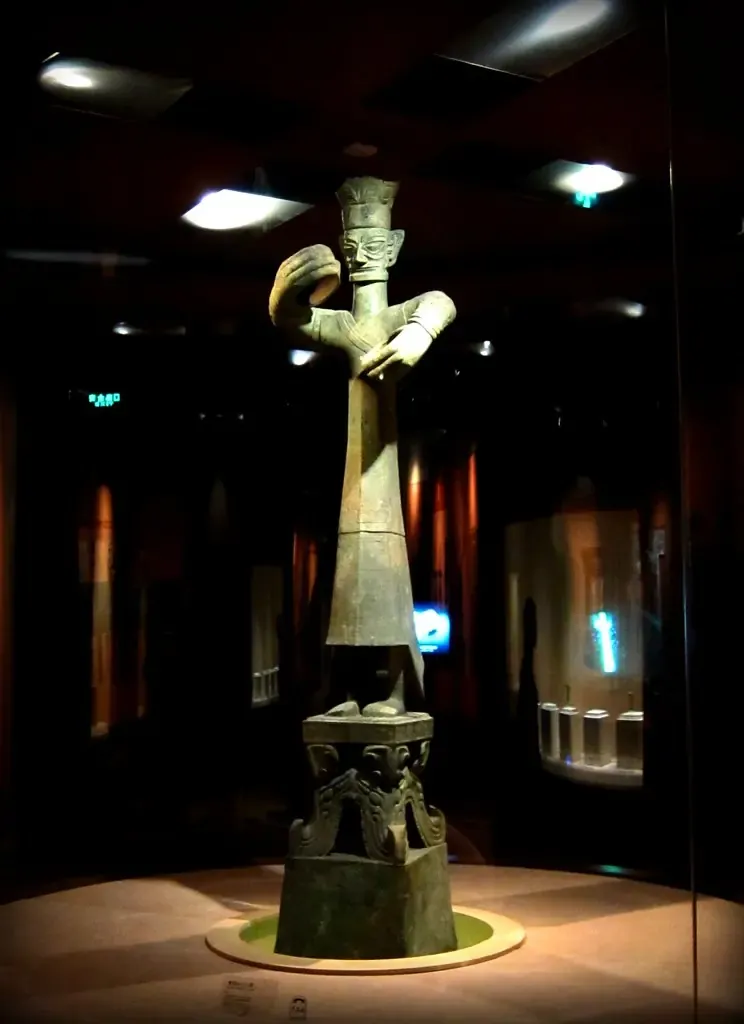
Photograph: kudumomo · CC BY 2.0 · Source
Held by: Sanxingdui Museum, Guanghan, Sichuan
The story
In 1986, workers digging clay at Sanxingdui in Sichuan broke into two sacrificial pits filled with burned and smashed treasure: gold masks, jade blades, elephant tusks, and bronzes of a style no one had seen, trees hung with birds, masks with eyes on stalks, and this figure. He stands 1.8 metres on his own, 2.6 with his base: crowned, in layered robes cast with their patterns, barefoot, his enormous hands ringed around an object that did not survive, perhaps an elephant tusk, perhaps a gold staff.
Sanxingdui was the capital of the ancient Shu kingdom, a bronze civilisation contemporary with the Shang dynasty and quite unlike it, which buried its regalia in pits in a rite no text explains. The figure is the museum's emblem and the largest bronze human of the Chinese Bronze Age.
True size
True size. The height including the base of Sanxingdui Bronze Standing Figure is 2.6 m, set here against a standing person of 1.8 m so the scale reads at a glance.
The record, not the myth
What he held is guesswork from the grip. Who he is, king, priest or god, is unknown; Shu left no deciphered writing, and everything said about its religion is read off the objects.
Sources
Image and model credits
- Photographkudumomo · CC BY 2.0 · Source