
Artifacts · No. 44
Pyxis of al-Mughira
An ivory box carved at Madinat al-Zahra for a teenage Umayyad prince, covered in court scenes and an inscription that dates it: the masterpiece of Cordoban ivory.
968Zoomable photographFamily viewing: YesCatalogue: OA 4068
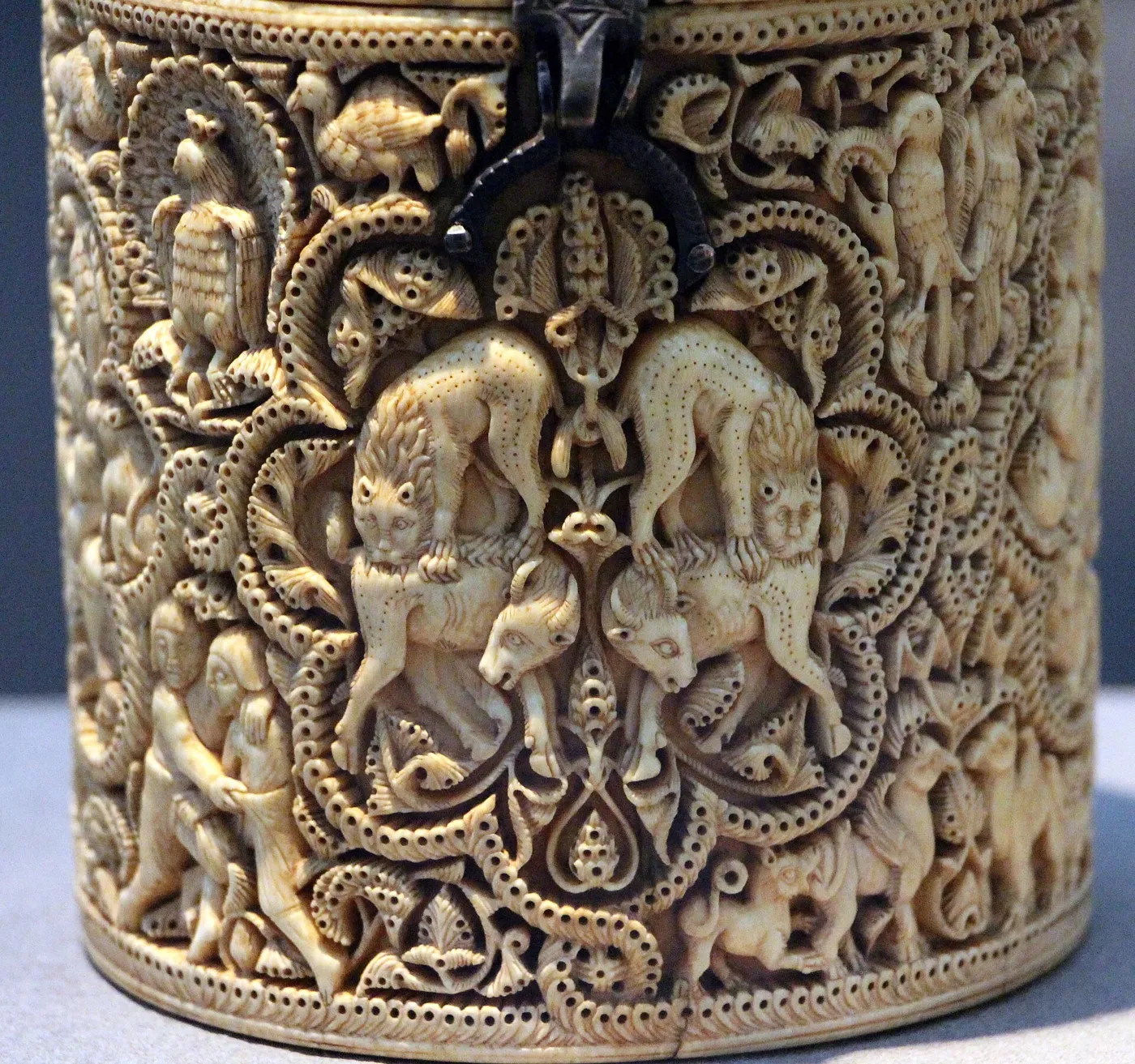
Photograph: Sailko · CC BY 3.0 · Source
Held by: Musée du Louvre, Paris · Catalogue OA 4068
Seeing it. As of November 2026 the pyxis is on loan to Louvre Abu Dhabi until 31 July 2027, then to the Hôtel de la Marine, Paris, until 31 March 2028 (Louvre).
The story
In 968, in the palace city of Madinat al-Zahra outside Cordoba, ivory carvers made this round box for al-Mughira, youngest son of the caliph Abd al-Rahman III, then about eighteen. The carving runs in four medallions: men picking dates, a courtier with a fan, a prince entertained by musicians, an egg snatching scene whose meaning scholars still chase, and between them lions, peacocks, gazelles and horsemen, cut so deep the figures nearly stand free of the wall. An inscription band around the lid gives the prince's name and the year, which is why the box can be dated to the year and the workshop to the palace.
Ivory pyxides were gifts at the caliph's court, perfume or jewel boxes for the royal family. This one reached the Louvre in the nineteenth century, its travels in between unrecorded. It is currently away from Paris on the loan stated below.
The band around the lid
“Blessing, prosperity, well being and happiness to al-Mughira, son of the Commander of the Faithful, may God keep him. This was made in the year 357 (of the Hijra, AD 968).”
The inscription names the recipient and the year, the anchor for the whole dating of Cordoban ivory carving.
The record, not the myth
The scenes' programme, a lesson for a prince, a celebration, a warning about succession, is read differently by every generation of scholars; the inscription is the only part that speaks plainly. The amateur 3D model of it online is a reference, not a scan, and is not embedded here.
Sources
Image and model credits
- PhotographSailko · CC BY 3.0 · Source