
Artifacts · No. 11
Pylos Combat Agate
A seal stone 3.5 centimetres long carved with a full battle scene in detail finer than a hair: the masterpiece that rewrote what Bronze Age Greek art could do.
c. 1450 BCZoomable photographFamily viewing: No
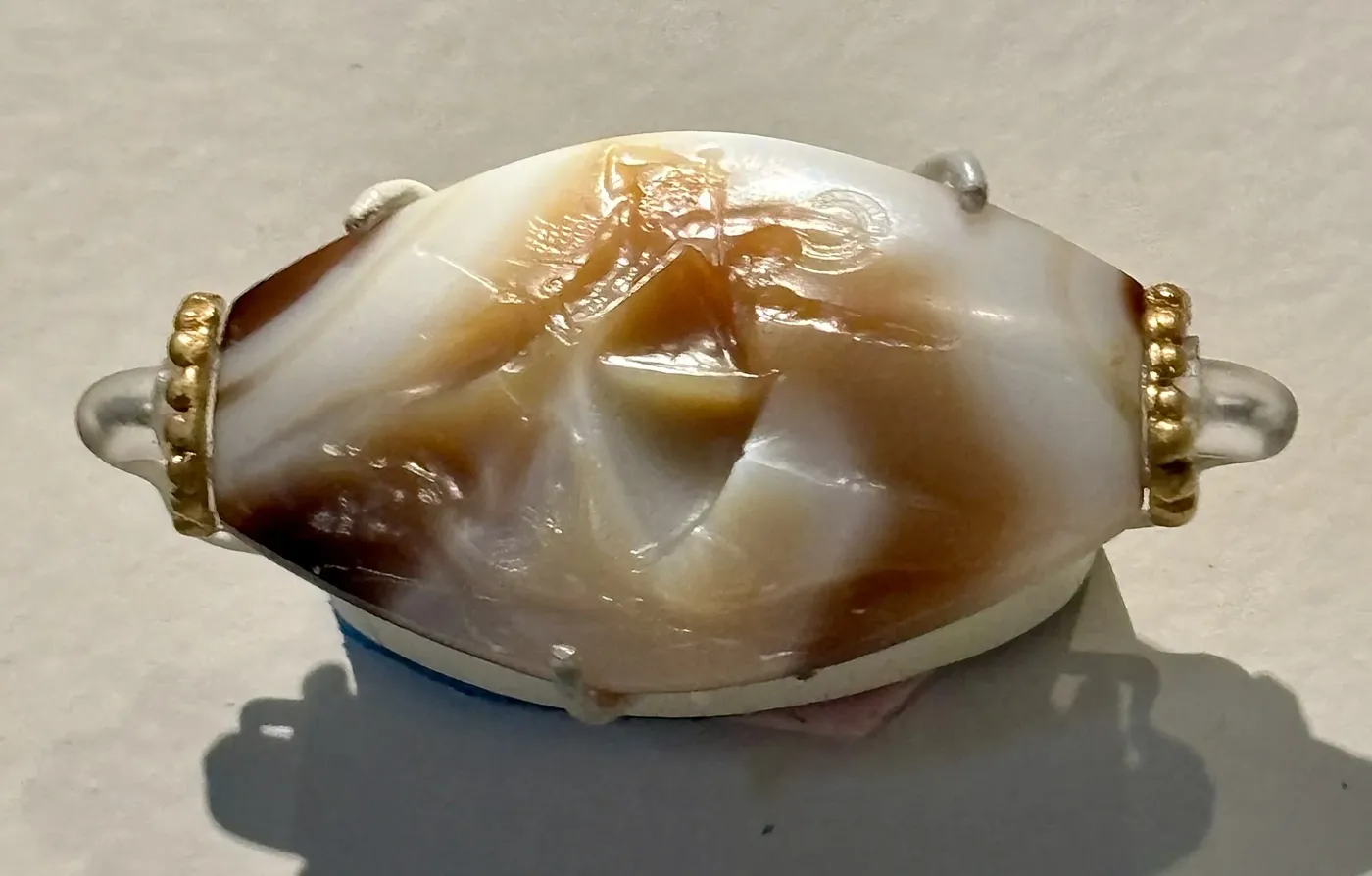
Photograph: Jengod · CC BY-SA 4.0 · Source
Held by: Museum of Hora (Chora), Messenia
Seeing it. As of November 2026 the agate is on loan, shown at the Getty Museum and then the Metropolitan Museum of Art through 2026. Its home museum is at Chora in Messenia.
The story
In 2015, excavators from the University of Cincinnati working beside the Palace of Nestor at Pylos opened the grave of a warrior buried around 1500 BC with his sword, gold and this seal stone. Cleaned of its lime crust, the agate showed a scene no one expected at that date: a warrior driving his sword into an enemy's neck while a second foe lies dead at his feet, shields, spears, helmets and musculature all cut into a stone 3.5 centimetres long, some lines a tenth of a millimetre wide.
Work like this was thought to belong centuries later. The agate forced a rewrite of how Bronze Age Aegean craftsmen are rated, and it is still travelling: it was on loan to the Getty and then the Metropolitan Museum of Art in 2025-2026. Its home is the small museum at Chora, near the palace where its owner was buried.
True size
True size. The length of the seal stone of Pylos Combat Agate is 3.5 cm, set here against a standing person of 1.8 m so the scale reads at a glance.
The record, not the myth
The grave's owner is unknown; Griffin Warrior is the excavators' name for him, from the ivory griffin plaque buried with him. Who carved the seal, and where, is argued: Cretan workmanship is the leading view.
Sources
Image and model credits
- PhotographJengod · CC BY-SA 4.0 · Source