
October 6, 2026
Vlad the Impaler
A field outside Târgoviște, June 1462. An Ottoman army under Sultan Mehmed II, the same man who had taken Constantinople nine years earlier and ended the Byzantine Empire, marched north expecting to crush a small Wallachian prince and absorb his land.
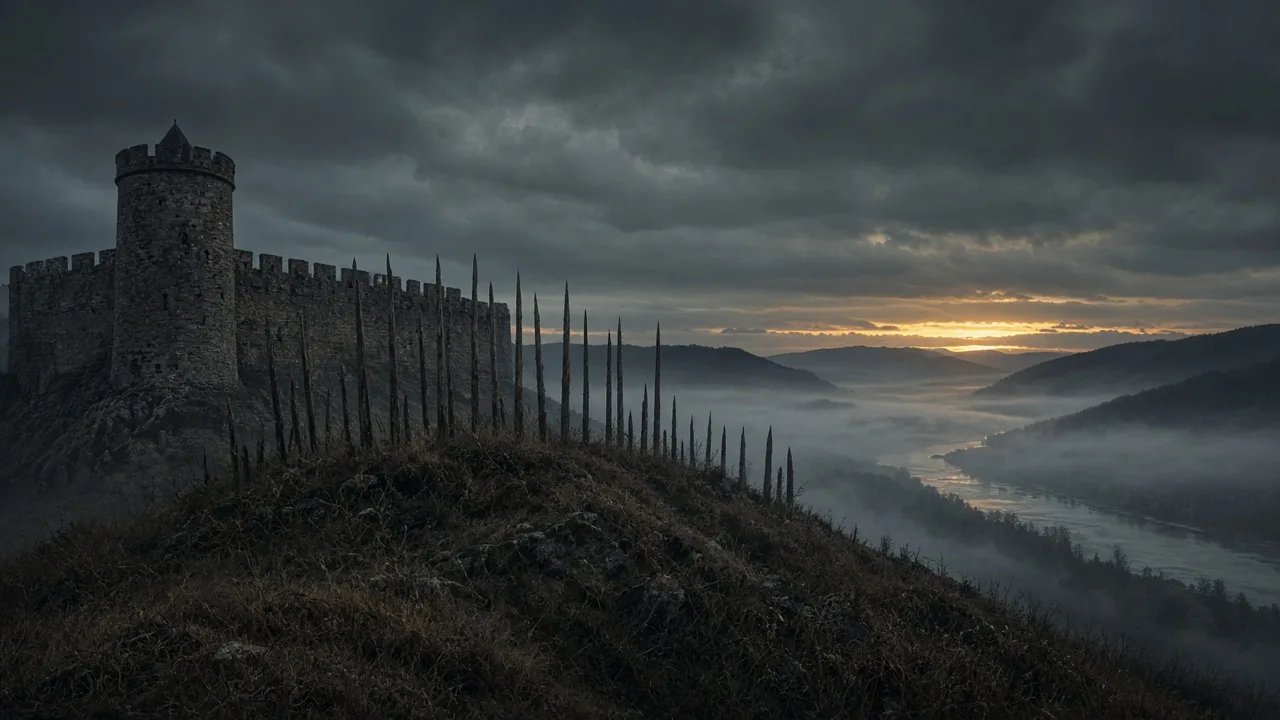
A field outside Târgoviște, June 1462. An Ottoman army under Sultan Mehmed II, the same man who had taken Constantinople nine years earlier and ended the Byzantine Empire, marched north expecting to crush a small Wallachian prince and absorb his land. What the army found instead was a landscape of wooden stakes stretching for roughly a mile, each one carrying a body. The Byzantine chronicler Laonikos Chalkokondyles, writing not long after, put the number at close to twenty thousand men, women, and children. Mehmed, according to the same account, looked at the scene and turned his army around. This is the image history has kept of Vlad III, prince of Wallachia. One of the strongest examples of the importance of borders.
To understand why a man built a mile of corpses to stop an empire, you must first understand the geopolitics of his time. Wallachia sat on the lower Danube, sitting between the Kingdom of Hungary to the north and the expanding Ottoman Empire to the south. It was not powerful enough to defeat either neighbor outright. It survived through tribute and shifting alliances. Princes who lost control were killed, replaced, or driven out by foreign armies. This was the world Vlad was born into.
Vlad III was born between 1428 and 1431, most likely in the Transylvanian town of Sighișoara, then part of the Kingdom of Hungary. His father, Vlad II, held the title Dracul, meaning Dragon, earned through membership in the Order of the Dragon, a chivalric order founded in 1408 by King Sigismund of Luxembourg to defend Christian rule in Central Europe against Ottoman expansion. The son's later name, Dracula, means son of Dracul, son of the Dragon. In Romanian, the word dracul also came to mean devil over time, and that overlap of meaning did more to build the later legend than anything Vlad actually did.
In 1442, when Vlad was still a boy, he and his younger brother Radu were sent to the Ottoman court as political hostages, a common tool used by the Ottomans to guarantee the loyalty of vassal rulers. Vlad remained in Ottoman custody for several years. During that time he was educated inside the same imperial system he would later spend his adult life fighting. He learned Ottoman court politics, military organization, and language during his stay. His brother Radu grew close to the Ottoman court and would later rule Wallachia as an Ottoman client, setting the two brothers permanently against each other.
While Vlad was still a hostage, his father was killed in 1447 by forces tied to rival Wallachian nobles called the boyars, acting with Hungarian involvement. His older brother Mircea was murdered as well, reportedly buried alive by his enemies in Târgoviște. Vlad returned to Wallachia the following year and briefly seized the throne in 1448, but he held it only a matter of weeks before being pushed out again. It would take him eight more years to return for good.
In 1456, Vlad took the Wallachian throne a second time, defeating his rival Vladislav II, and this reign, lasting until 1462, is the one that defined him. He moved immediately against the boyars who had killed his father, executing many and replacing the old aristocratic power structure with men loyal directly to him. He punished Saxon merchant communities in Transylvania who defied his authority or backed his rivals, and contemporary Saxon letters describe impalements carried out against them at scale. Those letters have to be read carefully, since they come from a community with every reason to make Vlad look as monstrous as possible. Modern historians do not dismiss the underlying events, only the numbers attached to them.
Impalement had been used for centuries across the region, including by the Ottomans Vlad had learned from. What made Vlad's use of it different was scale and intent. A public execution in the medieval world was a message to anyone watching about what would happen if you broke the law. Vlad used that message more aggressively and more visibly than most rulers of his time, and he used it as a central instrument of state defense in a principality that had no other reliable way to hold itself together against internal rivals and external empires.
In 1462, Vlad refused to pay the tribute the Ottoman Empire demanded and refused to appear in person to pay homage to the Sultan. This act was in Ottoman diplomatic practice effectively a declaration of defiance. He then crossed the Danube into Ottoman territory, burning towns and killing along the way. In a letter to King Matthias Corvinus of Hungary dated 11 February 1462, Vlad reported that his forces had killed 23,884 Turks and Bulgarians during the campaign, a figure that included those burned in their homes and those whose heads were never brought back to be counted.
When Mehmed II marched north that June to attempt to end the revolt personally, Vlad attempted a night attack on the Sultan's camp, trying to kill him directly. The attack failed to reach Mehmed. What the Ottoman army found days later, according to Chalkokondyles, was the field of the impaled outside Târgoviște. A recent quantitative reassessment of the sources, published in 2025 by the historian Dénes Harai in Transactions of the Royal Historical Society, concludes that only a fraction of the individual impalements claimed across all surviving sources can be considered historically plausible, and proposes a lower, data based estimate in place of the round numbers handed down by chroniclers. The event itself, a mass display of impaled bodies used as psychological warfare against an invading army, is accepted as real. The exact count is still debated.
Vlad did not hold onto Wallachia after this campaign. Facing pressure from both the Ottomans and his own Hungarian ally, he lost the throne later in 1462 and was taken into custody by Matthias Corvinus, the same king he had written that letter to only months before. Vlad spent roughly the next decade imprisoned in Hungary, primarily at Visegrád, in conditions that improved over time. He reportedly converted to Catholicism and married into the Hungarian royal family during this period, a political arrangement that eventually restored him to Corvinus's favor. Meanwhile his brother Radu ruled Wallachia as an Ottoman vassal, the very outcome Vlad had spent his second reign trying to prevent.
Vlad was released around 1475 and fought alongside Hungarian and Moldavian forces in campaigns against the Ottomans in the following year, eventually retaking the Wallachian throne for a third time in November 1476 with foreign military backing. Vlad was killed in battle near Snagov, close to modern Bucharest, in either late 1476 or early 1477, fighting to hold a throne he had now won and lost three times. There are conflicting accounts of his death. Some sources describe him falling in open combat against Ottoman forces, others suggest he was killed by his own men in the confusion of the fighting. Ottoman accounts report that his head was sent to Constantinople as proof of the death of an enemy the empire had never fully managed to control. Tradition places his burial at Snagov Monastery, though archaeological excavation there has never confirmed a tomb.
Vlad's legacy is that of a ruler who inherited a principality that could be destroyed by either of its neighbors at any time, who spent his hostage years learning the methods of the empire he would later fight, and who used terror as calculated policy rather than as an expression of private appetite. The letter of 11 February 1462 and the field Chalkokondyles described were the tools of a man trying to make the cost of invading his small country too high for a much larger empire to pay. Whether that calculation was justified, admirable, or monstrous is a question for God to decide.
Comments
Loading comments…