
October 6, 2026
The Khmer Rouge
The forced evacuation of Phnom Penh on April 17, 1975, remains one of the most drastic urban clearances in modern history. As armed columns of the Khmer Rouge entered the Cambodian capital, signaling the end of the civil war, the new regime immediately issued orders emptying the city.
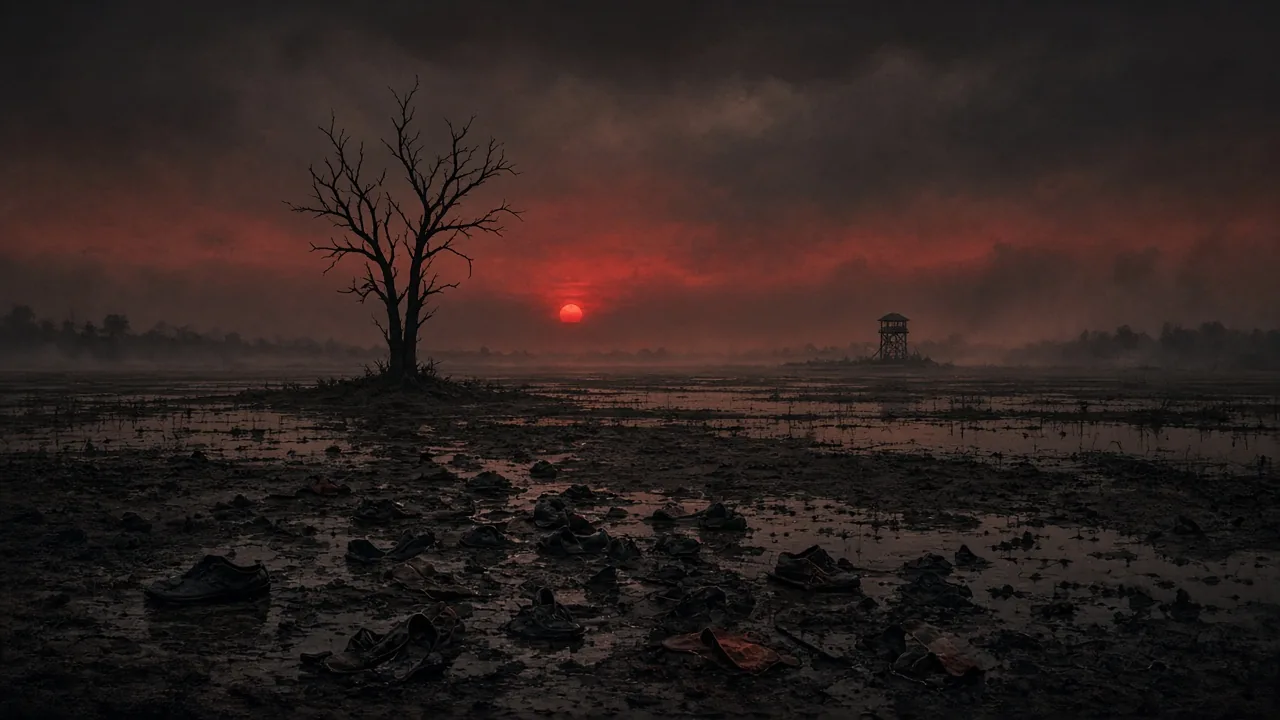
The forced evacuation of Phnom Penh on April 17, 1975, remains one of the most drastic urban clearances in modern history. As armed columns of the Khmer Rouge entered the Cambodian capital, signaling the end of the civil war, the new regime immediately issued orders emptying the city. Reporting for The New York Times, Sydney Schanberg remained behind to witness the transformation, earning a Pulitzer Prize for documenting how a bustling metropolis became an echo chamber of deserted streets, abandoned vehicles, and empty shops. Approximately two million residents—including more than a million refugees who had fled rural fighting—were marched into the countryside at gunpoint. Party cadres instructed citizens that the move was a temporary precaution against impending American bombing raids, promising they would return in two or three days and assuring them that Angkar ("The Organization") would safeguard their homes. Hospitals were systematically cleared alongside residential neighborhoods, with the sick and injured forced directly into the roads. Observing the exodus, French priest François Ponchaud posed the fundamental question hanging over the enterprise: why had the victors chosen to forcibly displace more than two million of their own citizens?
Behind euphemistic vocabulary lay a sweeping effort to erase existing society and inaugurate what the regime termed "Year Zero". Under Angkar, currency was abolished, markets were banned, private property was outlawed, religion was forbidden, and formal education was suspended. The population was divided into two distinct classes: "base people," the rural peasantry trusted by the party, and "new people," the urban deportees subjected to hard labor and ideological purging. Citizens were organized into mandatory agricultural cooperatives where political slogans underscored the regime's total disregard for individual life: "To keep you is no gain; to lose you is no loss," "To dig up the grass, one has to remove even the roots," and "It is better to arrest ten people by mistake than to let one guilty person go free". As journalist John Pilger observed, Year Zero represented the total dismantling of family structures, medicine, literature, and art, reducing existence strictly to forced labor and survival.
The operational center of the regime's political purges was S-21, a former Phnom Penh secondary school converted into a central interrogation and detention facility. Directed by Kaing Guek Eav (known as "Duch"), S-21 processed over 14,000 prisoners who were systematically tortured into signing fabricated confessions detailing non-existent plots with foreign intelligence agencies. Historian David Chandler notes that fewer than a dozen individuals left the facility alive, spared primarily for specialized skills such as painting or mechanical repair. Once interrogations were concluded, surviving detainees were transported to Choeung Ek, an orchard southwest of the capital. There, an estimated 17,000 men, women, and children were executed, often with blunt farm tools to preserve ammunition. Subsequent exhumations recovered 8,985 bodies from mass graves at the site, with over 8,000 human skulls ultimately preserved inside a memorial stupa. In 2025, the site was officially designated a UNESCO World Heritage memorial.
The human toll of the four-year regime has been documented through extensive demographic analysis. Academic consensus places total excess mortality between 1.5 million and 2.0 million people, representing roughly one-fifth to one-fourth of Cambodia's pre-war population. Studies by Yale historian Ben Kiernan calculate the death toll at 1.671 to 1.871 million individuals. Demographic modeling by UCLA researcher Patrick Heuveline established a median estimate of 1.9 million excess deaths, while demographer Marek Sliwinski calculated that 33.5 percent of Cambodian men and 41.9 percent of Phnom Penh’s original population perished. The higher figure of 3.3 million, often cited by post-regime authorities, resulted from earlier surveys that double-counted victims across partially exhumed grave sites.
The Khmer Rouge was driven from power when Vietnamese forces captured Phnom Penh on January 7, 1979, but judicial accountability proceeded slowly. Decades later, the United Nations-backed Extraordinary Chambers in the Courts of Cambodia brought key figures to trial. In 2010, the tribunal convicted Duch for his management of S-21. In 2018, the court convicted Nuon Chea ("Brother Number Two") and Khieu Samphan (former head of state) of genocide against ethnic Vietnamese and Cham Muslim minorities, alongside convictions for crimes against humanity covering mass deportations, forced labor, and executions across the broader population. Today, Cambodians mark May 20 as a national day of remembrance, preserving the factual record of Year Zero and honoring the memory of those who perished.
Comments
Loading comments…