
October 6, 2026
Antonio Gramsci
Prosecutor Michele Isgrò stood before the Fascist tribunal in 1928 and demanded that the court stop Antonio Gramsci's brain from working for twenty years. The sentence handed down ran over twenty years, four months, and five days.
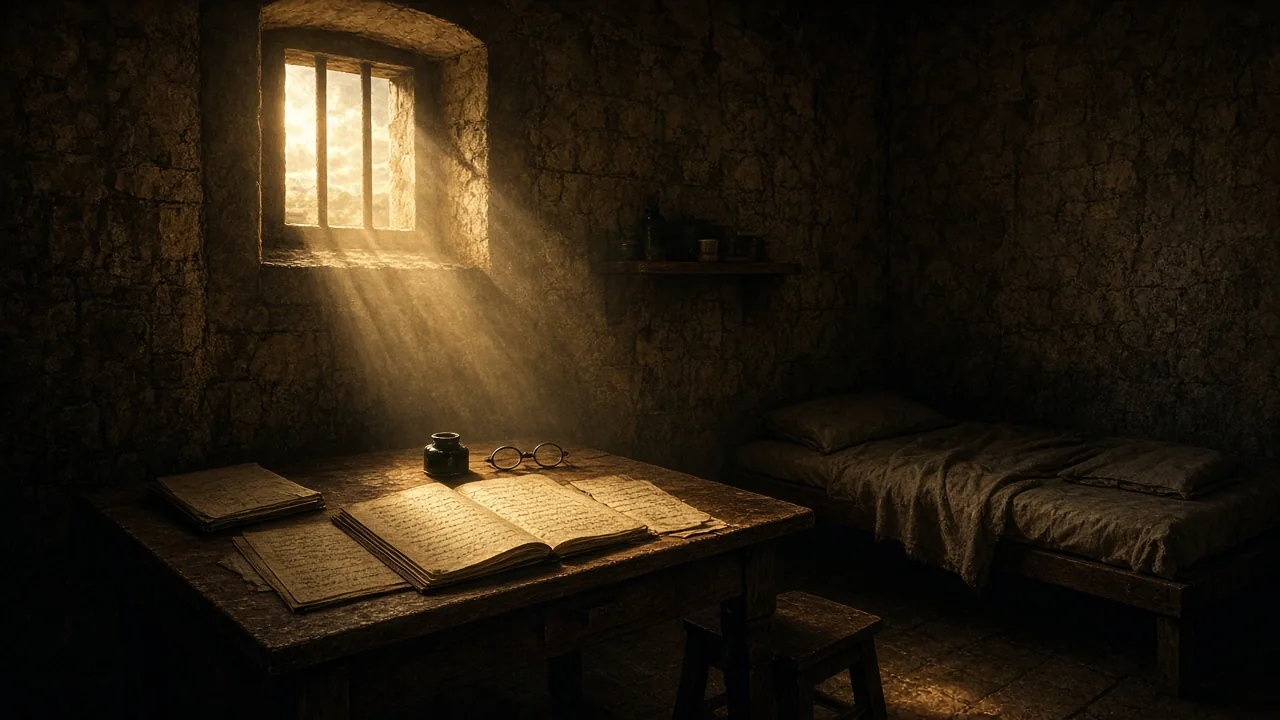
Prosecutor Michele Isgrò stood before the Fascist tribunal in 1928 and demanded that the court stop Antonio Gramsci's brain from working for twenty years. The sentence handed down ran over twenty years, four months, and five days. Yet the brain kept working. What it produced in prison, thirty-three handwritten notebooks totaling nearly three thousand pages, ultimately outlived the regime that tried to switch it off.
Antonio Gramsci entered the world on January 22, 1891, in the Sardinian town of Ales, the fourth of seven children. His father, a land registry clerk, was imprisoned on embezzlement charges that bore the marks of a local political vendetta. To feed the family, his mother sold inherited land and worked for years sewing, eventually settling in Ghilarza. The physical frame that later sat in a penal cell was forged in that childhood. Whether from an infant fall or untreated tuberculosis of the spine, he grew up hunchbacked, stopping short of five feet in height. Local doctors subjected him to painful treatments, suspending him from ceiling beams for hours, while schoolmates taunted him. He responded by building makeshift weights from stones and an old broom handle, refusing to succumb to self pity.
After working in the land registry as a boy, Gramsci won a scholarship in 1911 for poor students from the Sardinian provinces, allowing him to enroll at the University of Turin. In Turin he studied linguistics and literature, reading deep into philosophy and historical critique. Poverty, physical pain, and political commitments eventually cut his formal degree short, turning him into a full time journalist and socialist militant.
By late 1914, Gramsci was already writing sharp political commentary. He published polemics in socialist papers, organized workers circles, and drafted early manifestos condemning political indifference. Following the 1917 repression in Turin, he stepped into leadership within the city's socialist organization. That same year, he published his famous reaction to the Russian Revolution, declaring it a revolution against the traditional interpretation of Karl Marx's Capital. He argued that the Bolsheviks had proven historical materialism was not a rigid, deterministic track, striking an early blow against economic fatalism.
In 1919, he cofounded the publication L'Ordine Nuovo, which helped reorient Italian radical politics. Gramsci championed factory councils as the embryonic structure of a future workers state. Strikes erupted, factories were occupied, and the revolutionary momentum peaked before breaking. During these intense years, he adopted the famous motto, pessimism of the intellect, optimism of the will, drawing it from the French writer Romain Rolland to describe the necessary mindset for revolutionary struggle.
Gramsci helped found the Communist Party of Italy at Livorno in 1921. Sent to Moscow in 1922 as a delegate to the Communist International, he met Julia Schucht, who became his wife and the mother of his two sons. Electing him to parliament in 1924 provided temporary immunity, allowing him to return to Italy to lead the party against rising Fascism. He consolidated organizational power, authored major analytical thesis documents on Italian society, and wrote on the Southern Question. In that unfinished analysis, he detailed how northern industrial workers had to build alliances with southern peasants, breaking the intellectual armor that bound rural populations to wealthy landowners.
In October 1926, seeing the dangers of Soviet factionalism, Gramsci wrote to the leadership in Moscow warning that internal division threatened the revolutionary movement. Party representatives held back the letter, leading to an intense exchange of disagreements over strategy. Weeks later, Mussolini's regime enacted extraordinary laws. Gramsci was arrested, his parliamentary immunity ignored, and he was placed in confinement.
Following a prolonged period of interrogation, his trial began in May 1928 before the Special Tribunal for the Defense of the State. Charges included conspiracy, instigation of civil war, and incitement to class hatred. Following his heavy sentence, severe illness diverted him to the penal institution for the infirm at Turi. Initially housed with other political prisoners, he eventually obtained a cell of his own, along with ink and paper. Political tensions within the prison ran high. When Gramsci rejected rigid new party lines pushed from Moscow, fellow communist prisoners isolated him.
Permission to write in his cell arrived in early 1929. On the first page of his first notebook, he laid out a plan of research. Between 1929 and 1935, despite failing health, he produced thirty-three notebooks containing extensive reflections on history, culture, and power. He was sustained through these years by his sister in law Tatiana Schucht and by an open book account maintained for him by the economist Piero Sraffa. Gramsci refused to petition the regime for clemency, holding that asking Mussolini for a pardon would mean moral suicide.
His physical condition steadily deteriorated. After collapsing in 1933, he was transferred under guard to medical clinics in Formia and later Rome. His official sentence expired in April 1937. Just days after gaining conditional freedom, a cerebral hemorrhage struck. He died on April 27, 1937, with Tatiana at his bedside. He never saw his wife or sons again, leaving behind only letters and fables written from prison for children he could not visit. Tatiana secured the notebooks, hiding them in bank vaults before sending them by diplomatic pouch to Moscow, where they survived the war.
What emerged from those prison pages transformed modern political thought. Gramsci rethought the concept of cultural hegemony, demonstrating that power is not maintained by state force alone, but by a reform of consciousness and the creation of social consent across civil society. He drew a famous distinction between the political conditions of East and West, noting that while the state in Russia was everything and civil society was weak, Western states were backed by a dense system of civil institutions, fortresses and earthworks that required a long war of position rather than a sudden assault.
He analyzed organic crises, famously writing that such moments occur when the old world is dying and the new cannot be born, giving rise to a wide variety of morbid symptoms. He explored how every social group creates its own organic intellectuals, examined the role of popular folklore, and analyzed modern industrial methods under Fordism, arguing that while repetitive factory labor seeks to mechanize the body, it leaves the worker's mind free to think.
His legacy remains complex and contested. The leader who theorized consent and civil society was also a firm party enforcer who implemented strict discipline. His insights were later claimed by political movements across the spectrum, from European reformists to postcolonial theorists and cultural scholars. Stripped of simple mythologizing, the history reveals a thinker who diagnosed the mechanisms of power with extraordinary clarity, writing through isolation and physical ruin to leave behind an enduring body of work
Comments
Loading comments…