
Then and Now · E7
Çatalhöyük
The reconstruction follows Hodder's Çatalhöyük Research Project: a town of mudbrick houses packed wall to wall with no streets, where life ran across the rooftops and down ladders. The photograph shows the excavated mound under its shelter, a few walls standing of the thousands of houses.
Then: The Neolithic town entered through roofs, about 7100 to 5950 BCAI reconstructionFamily viewing: Yes
 ThenNow
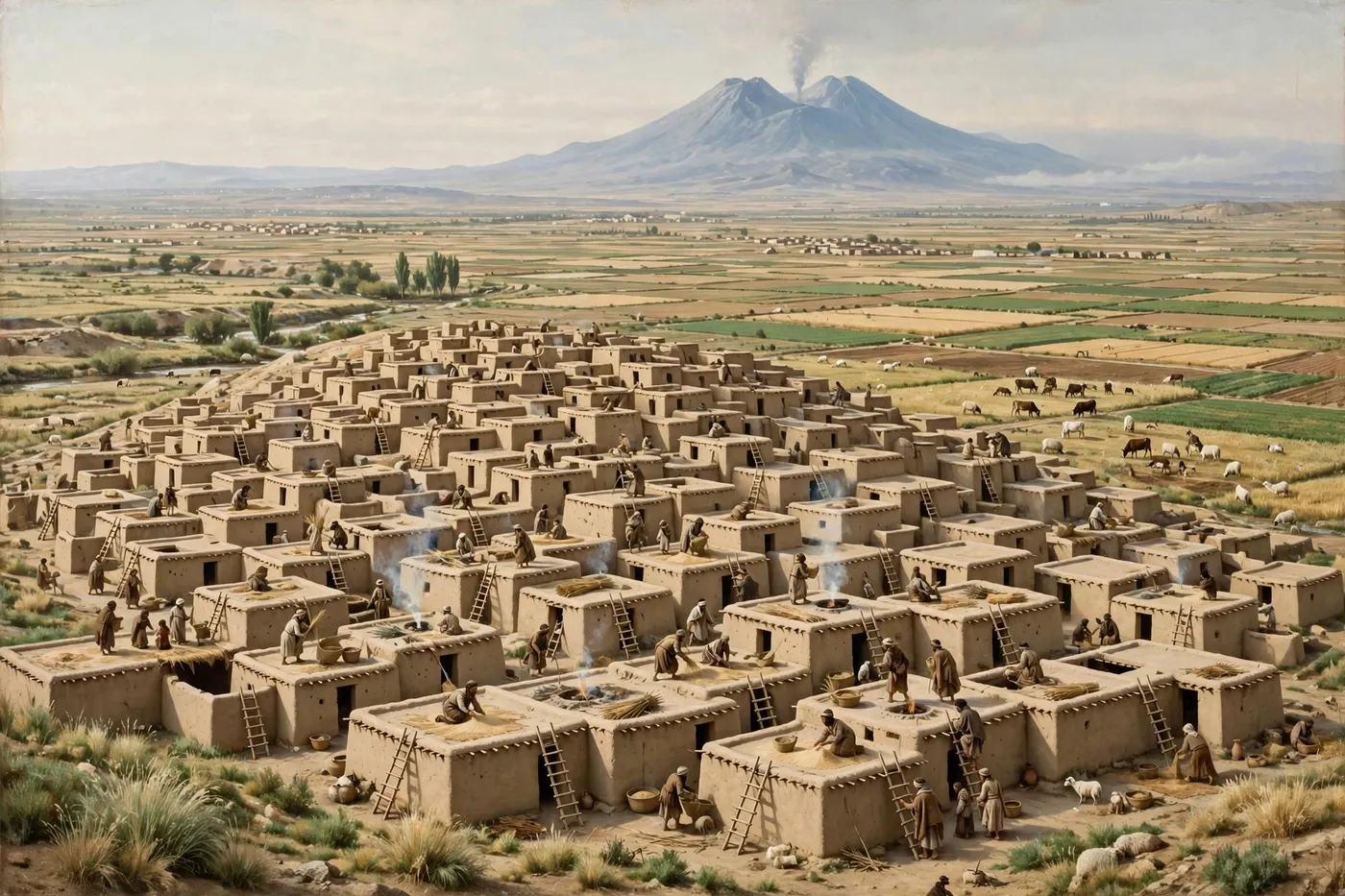
Then. The Neolithic town entered through roofs, about 7100 to 5950 BC. This view is an AI reconstruction, built from the scholarship cited below. It is not a photograph.
Now. A real photograph of the place as it stands.
Did you know? The dead were buried under the floors of the houses, some skulls removed, plastered and painted, and kept in circulation among the living before burial again. Ancestors were part of the furniture.
Then and now
Çatalhöyük, on the Konya plain, housed perhaps 8,000 people at its height in houses entered from the roof, with no streets and no public buildings anyone can identify. Its rooms held platforms, ovens, burials under the floor, and walls painted with hunts, vultures and the pattern of the town itself, beside the bull heads modeled in plaster.
James Mellaart dug the south mound in the 1960s; Ian Hodder's project worked it for twenty five years with fine grained methods that rewrote what a dig records. The photograph shows the north shelter over the excavated houses, low mudbrick walls in a grid of rooms. Mellaart's "Mother Goddess" reading of the figurines is outdated, and some of his site drawings are now suspected forgeries, which the record states plainly.
What changed. An excavated mound under shelter roofs; low walls survive.
The record, not the myth
Mellaart's "Mother Goddess" is outdated; some of his drawings are suspected forgeries.