
Wednesday 11 November 2026
Four million workers join Spain's first general strike in 14 years over the cost of housing
Unions say four million Spanish workers took part in a 24 hour general strike on Wednesday, the country's first since 2012, called over a housing shortage that has pushed rents beyond the reach of a working wage. The strike, backed by Spain's two largest unions and by tenants' associations, disrupted transport, ports and car factories three weeks before a snap general election on November 29. Employers dispute the unions' count and put participation far lower. Prime Minister Pedro Sanchez, whose government faces housing votes in parliament on Thursday, backed the strike's demands.
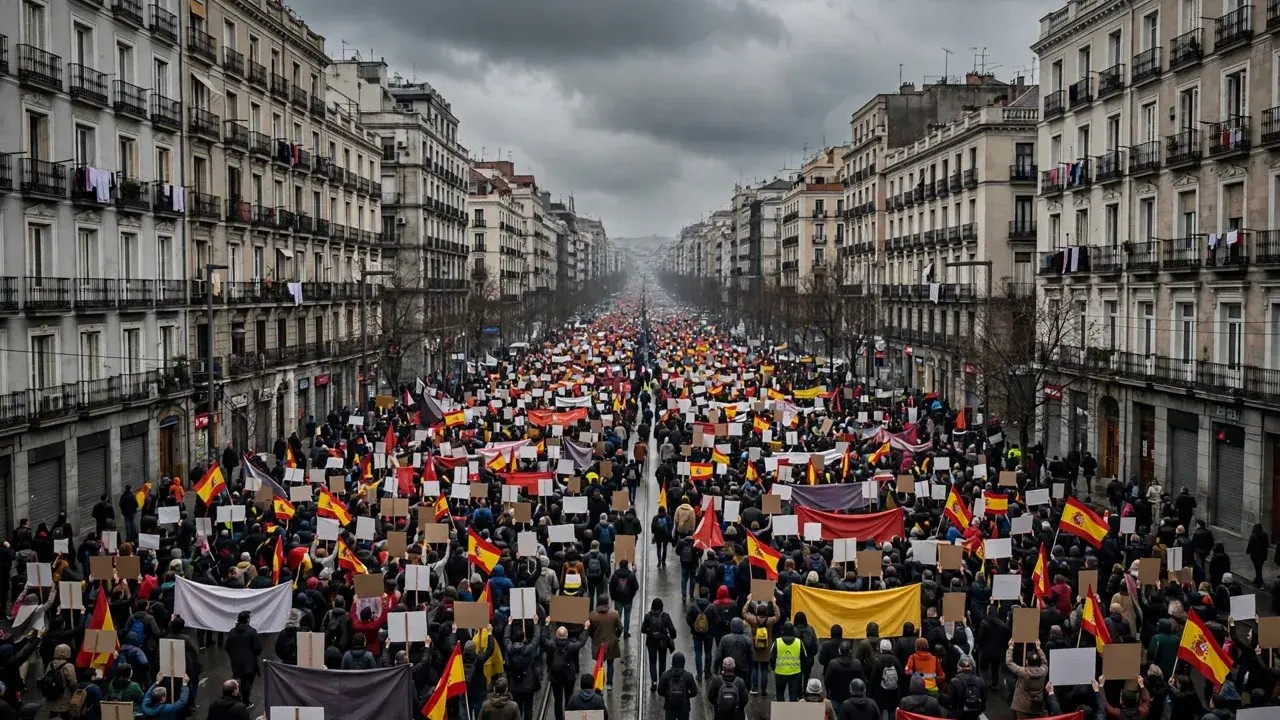
Spain stopped on Wednesday, November 11, for the first time in 14 years. The 24 hour general strike was called jointly by the country's two largest unions, UGT and CCOO, together with tenants' associations, under the demand that wages cover the cost of a place to live. The unions said four million workers took part, and the tenants' union said it expected the count to reach five million by the end of the day, in a country of about 23 million workers. The employers' confederation CEOE put average participation at about 5 percent. The two sets of figures measure the day differently and neither side accepts the other's.
The disruption was real whatever the count. Public transport ran at minimum service levels, Madrid Metro use in the peak hours ran 42 percent below the same period a week earlier, Barcelona's Metro ran only at commuting peaks, and more than 280 flights were cancelled during the day, according to El Pais. Ports and car factories reported heavy stoppages. The Interior Ministry recorded hundreds of incidents connected to the strike across several cities, and at least 42 people were arrested, as of Wednesday afternoon, November 11. Electricity use in the morning ran 7.5 percent below the grid operator's forecast for an ordinary day.
The grievance underneath the strike is arithmetic. The Bank of Spain puts the country's housing shortage at about 750,000 homes, accumulated between 2021 and 2025, and expects it to pass a million by 2028 if building does not catch up with the growth in households. Social housing makes up only 1.5 to 1.7 percent of the housing stock, against a European Union average of 6 to 7 percent. The average advertised rent in Madrid reached 23.40 euros a square metre a month in October, and the Youth Council of Spain puts the average rent nationwide at 1,176 euros a month, which is 98.7 percent of a young person's average monthly salary. The campaign that produced the strike began outside the unions, in the tenants' movement, and it gathered force after the eviction in September of Maricarmen Abascal, an 87 year old Madrid pensioner with a disability.
The politics are pointed. Prime Minister Pedro Sanchez called the snap election for November 29 after his minority government failed to move its housing measures, and he defended the strike and its demands rather than condemning the disruption. His government brings two housing decrees to a vote in parliament on Thursday, November 12, covering lease renewals, eviction protections for vulnerable tenants and measures to build more affordable homes. The official election campaign opens on November 13. The strike gave the housing question the largest public stage it has had in Spain in years, three weeks before voters answer it.
Update, Thursday, November 12: The housing votes the strike was aimed at have now been held, and the two decrees split. The standing committee of Congress, the Diputacion Permanente, which acts while the Cortes are dissolved for the election, validated the government's main emergency housing decree law on Thursday, hours after the strike. That package extends lease contracts by two years in the cases it covers, protects vulnerable tenants against eviction without an alternative, regulates seasonal and room rentals, cuts income tax for owners who lower rents, raises VAT on tourist apartments to 10 percent and restricts purchases by investment funds. The second decree law, which would have made rental contracts effectively indefinite with compensation for tenants on termination, was rejected. The Basque PNV supported the main package and voted against the second, saying that measure had not been negotiated in advance. Opposition leader Alberto Feijoo says he would repeal the housing decrees if he governs after the November 29 election.
Spotted an error in this story? Email [email protected] and it will be checked against the sources.