
Monday 9 November 2026
Trump meets Qatar's prime minister at the White House as Iran's terms stall and oil gives back 16 percent in a week
President Trump is scheduled to meet Qatar's prime minister, Sheikh Mohammed bin Abdulrahman Al Thani, in a closed door session at the White House on Monday, with Vice President JD Vance meeting him the same day, Reuters reported. Qatar is carrying the proposals between Washington and Tehran. Secretary of State Marco Rubio said on Sunday that the talks have made little progress and that Iran's demands remain unacceptable to the United States. Brent crude fell 16 percent in the week that ended on November 6, the largest weekly fall since the start of the COVID pandemic, and fell again in early trading on Monday, November 9.
The mediation came to the Oval Office on Monday. President Trump was scheduled to meet Sheikh Mohammed bin Abdulrahman Al Thani, Qatar's prime minister and foreign minister, in a closed door session at the White House, and Vice President JD Vance was scheduled to meet the Qatari leader the same day, Reuters reported. The meeting is Trump's first with a foreign leader since the midterm elections. Qatar has carried every serious proposal between Washington and Tehran for months, and the file it brought with it has two parts that do not yet fit together: an end to the fighting and a settlement of Iran's nuclear programme.
Tehran's terms are the sticking point. Secretary of State Marco Rubio spoke on Sunday before leaving Florida for the G7 meeting in Paris and said the negotiations have made little progress, saw no imminent breakthrough and regarded Iran's demands as unacceptable. Iran's foreign minister, Abbas Araghchi, has laid out a roadmap under which the United States would lift its naval blockade of Iranian ports, waive sanctions on Iranian oil sales, release an estimated 12 billion dollars in frozen Iranian assets and accept a ceasefire across the region, including Lebanon and Yemen. In return Iran would reopen the Strait of Hormuz late in the sequence and then begin talks on a final agreement, including the nuclear file. The Wall Street Journal reported on Friday that Trump had rejected that proposal. Iranian officials have since spoken of a shorter version under which Tehran would reopen the strait within 48 hours in exchange for the blockade ending and assets being released, which Iranian spokesmen called a sign of goodwill. Washington has announced no acceptance of either version.
President Trump set the public tone on Sunday, before the Qatari delegation arrived. He told CNN that renewed strikes on Iran are highly unlikely while talks progress, a judgment he repeated through that interview, and he said the economic pressure on Iran will bring its leaders to American terms. He also confirmed that Task Force Iron Gate, the unit stood up on Saturday to work against Iran's land and Caspian supply routes, is in full force. The blockade itself has not moved. The strait remains severely restricted, with a small number of ships crossing each day under one side's permission or the other's protection, and Iranian forces said overnight that no unauthorized vessel had used the southern passage after navigation aids there were destroyed, a claim no outside authority has verified.
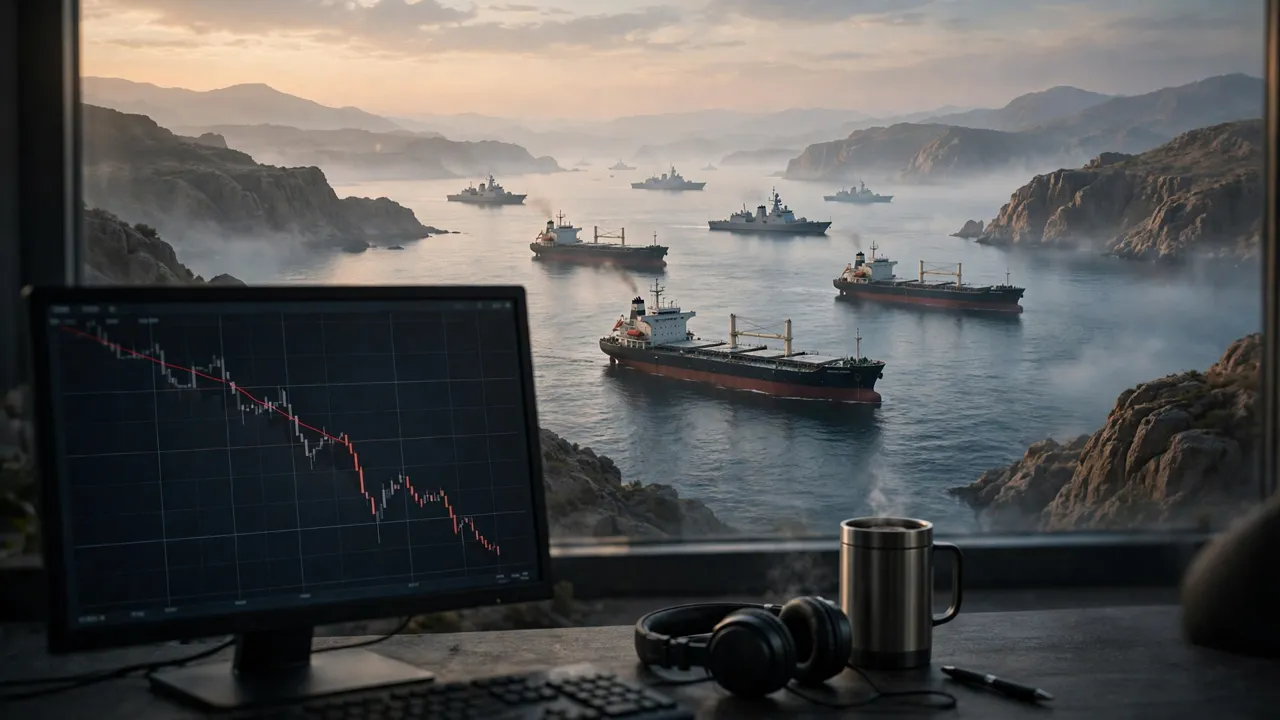
The market has started to price the diplomacy rather than the war. Brent crude fell 16 percent in the week that ended on November 6, its largest weekly decline since the start of the COVID pandemic, and closed that week at 98.32 dollars a barrel. West Texas Intermediate closed at 90.83 dollars. In early trading on Monday, November 9, Brent fell about 2 percent to about 96.38 dollars and West Texas Intermediate fell about 1.5 percent to about 89.56 dollars. Both grades remain about 50 percent higher than they were a year ago, before the war, and both are well below the levels near 120 dollars a barrel reached when the fighting was at its heaviest.
Nothing about Monday's meeting was announced in advance beyond the fact of it: no public remarks, no joint statement on the schedule. The war is in its ninth month. The blockade holds, the strait stays contested, and the only road either side is walking in public runs through Doha. Monday tests whether that road reaches anywhere.
Monday update: the meetings happened, and no deal came out of them. Sheikh Mohammed met President Trump and Vice President Vance at the White House on Monday, days after visiting Tehran. Iran's foreign ministry spokesman, Esmaeil Baghaei, defended Tehran's two day plan on Monday as the most reasonable offer on the table and demanded that Washington lift sanctions and the blockade before talks begin. Two unconfirmed reports described movement underneath the public positions: an Emirati outlet reported an American phased offer, beginning with a partial lifting of the blockade in exchange for reopening the strait, and an Israeli outlet reported that Qatar would present an Iranian approved proposal to reopen the strait in exchange for lifting the blockade and releasing 8 billion dollars in frozen assets. Neither report has been confirmed by any government. The shooting did not pause for the diplomacy. Iranian state media reported an American strike on Qeshm Island overnight into Monday, and a senior Iranian source told Reuters the strikes are targeting radar systems, missile launcher and mine laying bases. Attacks on tankers in the Gulf and around the strait ran in October at the highest rate since the war began. No statement from the White House announcing any agreement had been published as of Monday evening, November 9.
Trump put his own words on the state of the war on Monday. He told reporters the war is effectively over militarily, that taking further military action does not seem to be a very necessary thing, and that the United States remains locked and loaded, ready to go for any reason. He said Washington was keeping the status quo at the request of Iran's neighbours, that he saw positive momentum, and that he expected the conflict to end fairly soon. No agreement with Tehran has been announced. In Tehran, parliament speaker Mohammad Bagher Ghalibaf accused Israel, in a post on X on Monday, of working overtime to drag the United States into an endless war with Iran. His claim is Iran's official framing of the same week, and it is a claim, not a finding.
Spotted an error in this story? Email [email protected] and it will be checked against the sources.