
Tuesday 3 November 2026
Americans vote on Election Day with control of Congress hanging on a handful of races
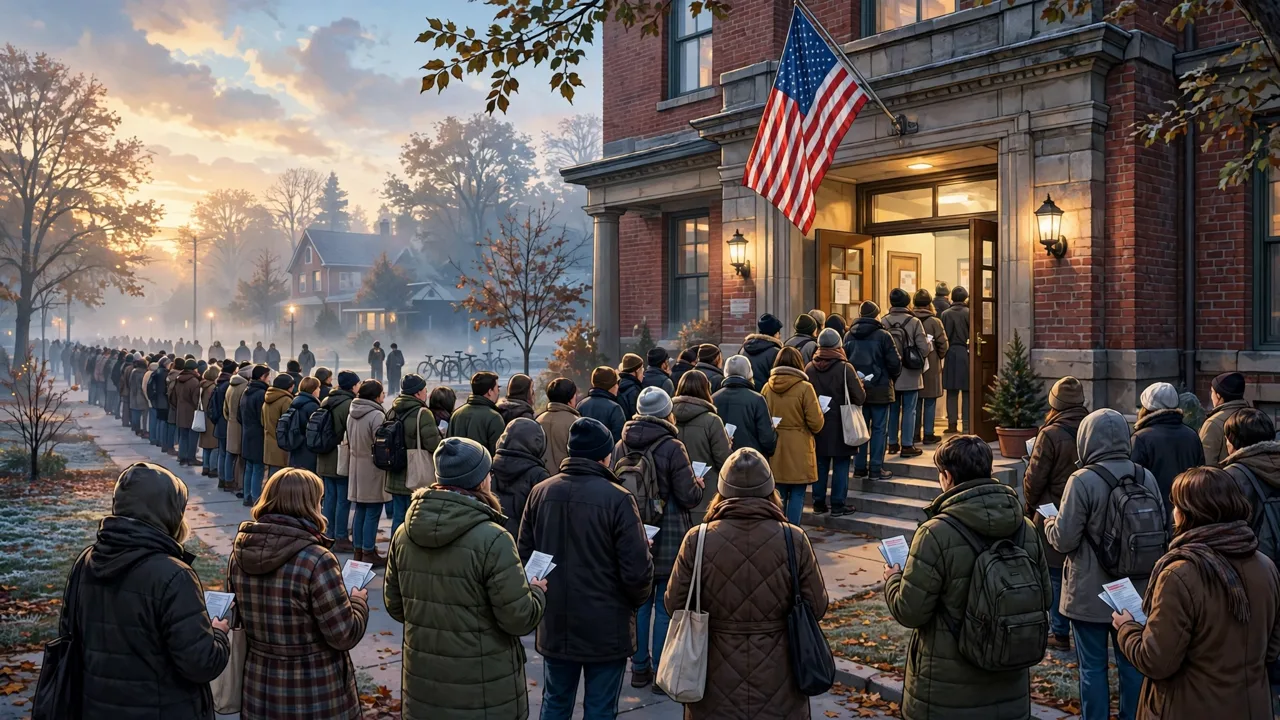
Voting is underway across the United States in the midterm elections that will decide who controls Congress for the last two years of President Donald Trump's second term. More than 57 million people had already cast ballots as of Monday, according to the University of Florida Election Lab, well above the 46 million who voted early in the 2022 midterms. All 435 House seats and 35 Senate seats are on the ballot, and 36 states are electing governors. Republicans defend a House majority of 218 to 214 and a Senate majority of 53 to 47. OpenSecrets projects total spending will reach 11.9 billion dollars, a record for a midterm, as of October 30. A Reuters and Ipsos poll put Trump's approval at 32 percent as of November 2.
The Senate is where the night will be decided. The Cook Political Report rates seven Senate races as toss-ups: Alaska, Iowa, Kansas, Maine, Michigan, Ohio and Texas. Six of those seats are held by Republicans. Democrats need a net gain of four seats to take the Senate and a net gain of three to take the House. Pollsters quoted by Reuters expect Democrats to win the House, while the Senate sits too close to call. Prediction markets put the chance of Democrats controlling the Senate at about 75 percent as of November 3. Those are forecasts, and the count that starts tonight is the only result that counts.
Texas carries the most expensive Senate race in American history outside a presidential contest. Republican Ken Paxton faces Democrat James Talarico, and advertising in the race has passed every record for a single state contest. In Michigan, Republican Mike Rogers faces Democrat Abdul El-Sayed, in a race that took a late turn on Sunday when Representative Haley Stevens, who lost the Democratic primary to El-Sayed, endorsed Rogers. Trump spent the final weekend rallying in Iowa and Kansas, two states his party once treated as safe, and he spent Monday night on social media attacking the challengers in Alaska and Michigan.
The Justice Department has sent 1,000 election monitors to cities and counties in all 50 states, which the department calls the largest monitoring effort in its history. Election lawyers told USA Today they are watching two things as the votes come in: the federal presence at polling places and legal attacks built on voter rolls. Several of those fights are already in court, and a separate story in today's news covers the voting charges the department announced on Monday and the court orders that have gone against the administration in the past week.
The money tells the scale of the fight. OpenSecrets tracked more than 9.5 billion dollars spent by mid October, with outside groups accounting for about 5.5 billion of it. Outside spending is expected to reach 3.9 billion dollars, up 85 percent from 2 billion in 2022, and untraceable contributions to outside groups have already reached 1.47 billion dollars, above the record set in 2024. Elon Musk is the largest single donor, at about 366 million dollars in support of Republicans in the campaign finance records filed as of three weeks before the vote, according to Reuters.
Polls close state by state through the evening, starting at 6 p.m. Eastern in parts of Indiana and Kentucky and ending at 1 a.m. Eastern in Alaska and Hawaii. The closest states may take days to finish counting. Alaska counts mail ballots over 10 to 15 days, so the final shape of the Senate may not be known for up to two weeks.
Spotted an error in this story? Email [email protected] and it will be checked against the sources.