
Tuesday 27 October 2026
Exit polls leave Israel deadlocked, with the opposition bloc ahead and neither side near 61 seats
Television exit polls published as voting ended on Tuesday put Gadi Eisenkot's opposition bloc at 52 to 53 seats and Prime Minister Benjamin Netanyahu's bloc at 50 in the 120 seat Knesset, as of October 27, short of the 61 seats a government needs. Likud remained the largest single party at 24 to 25 seats, and Arab led lists took 17 to 18. The Central Elections Committee is due to publish official results on November 4.
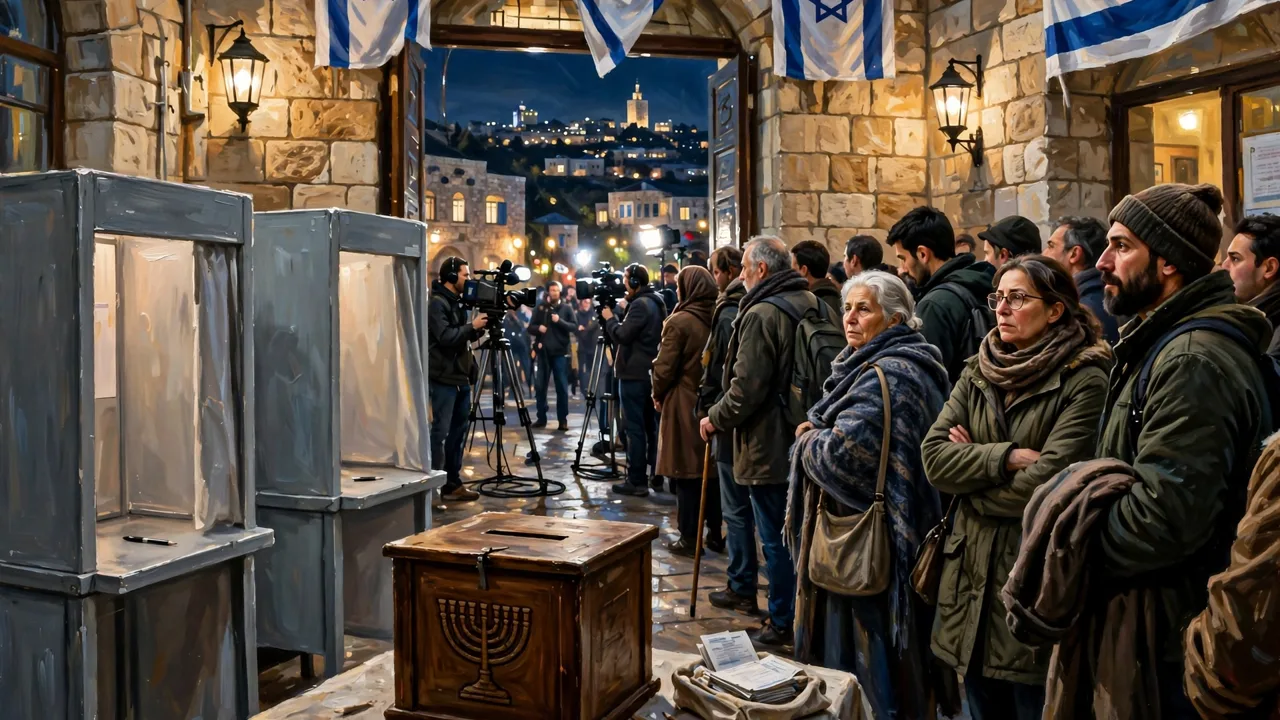
Israel voted all day, turned out in numbers the country has not seen in decades, and by 10 p.m. the exit polls had given it no winner.
Channel 12 put Likud at 24 seats and Eisenkot's Yashar at 22, with Netanyahu's bloc at 50 seats against 52 for the opposition. Channel 13 put Likud at 25 and Yashar at 23, and the opposition at 53. The public broadcaster Kan read the blocs the same way, 53 to 50. Channel 14, a network that supports Netanyahu, put his bloc at 60 seats, one short of a majority on its own count. Every poll left Arab led lists holding 17 to 18 seats, a large jump, and holding the balance between the two camps. Eisenkot claimed the night. "If these are the final results, they would mark a victory," he said. Yair Lapid, another opposition leader, went further. "Netanyahu's bloc suffered a tough defeat," Lapid said. "This is a total collapse and the public told them to go home."
Turnout drove the day. The Central Elections Committee put turnout at 74.3 percent at 8 p.m., two hours before the polls closed, against about 66 percent at the same hour in 2022, and broadcasters reported the highest final turnout in the country's history, with the final figure still to be published, as of October 27. Netanyahu spent the day warning that Arab voters were turning out in large numbers in the south, and wrote on X that "Muslim Brotherhood supporters are storming polling stations and stealing the election," NBC News reported. Police arrested three men in the Negev suspected of trying to buy votes for the Arab party Ra'am, and investigators said they found envelopes holding tens of thousands of shekels and ballot slips in searches of the suspects' homes. Eisenkot accused Netanyahu of laying the groundwork to contest the result.
The count decides what the exit polls cannot. Ballots are counted by hand, the committee publishes official results on November 4, and President Isaac Herzog then hands one leader the task of forming a government. Leaders in both camps have ruled out governing with the Arab parties whose seats now decide the arithmetic, so the bargaining runs through smaller parties first. Netanyahu stays on as caretaker prime minister while the talks run. If nobody builds 61 seats, Israel votes again.
Washington watches the count with its own stake in it. President Trump endorsed Netanyahu and joined Israel in the war on Iran, and Netanyahu told voters on Sunday that Trump was ready to act again against the Iranian threat only with Netanyahu still in power. Ophir Falk, a foreign policy adviser to Netanyahu, put the American question plainly. "The most crucial question, by far, is who will be Israel's prime minister during Trump's last two years in office?" he said. The exit polls say Israel has not answered it yet.
Spotted an error in this story? Email [email protected] and it will be checked against the sources.