
Saturday 24 October 2026
410,000 people march across France in a largely peaceful second Saturday, with clashes at the edges and nearly 1,000 arrests by evening
France second Saturday of protests drew 410,000 people nationwide by the Interior Ministry count, as of October 24, with unions claiming about 800,000. Some 110,000 marched in Paris. The vastly reinforced security force of 70,000 police and gendarmes averted a repeat of last weekend looting, though police fired tear gas and water cannon at hooded youths at the end of the Paris march and clashes flared in Marseille, Lyon and other cities. Interior Minister Laurent Nunez put arrests at 135 by early afternoon, and Fox News reported nearly 1,000 arrests by evening, citing Nunez.
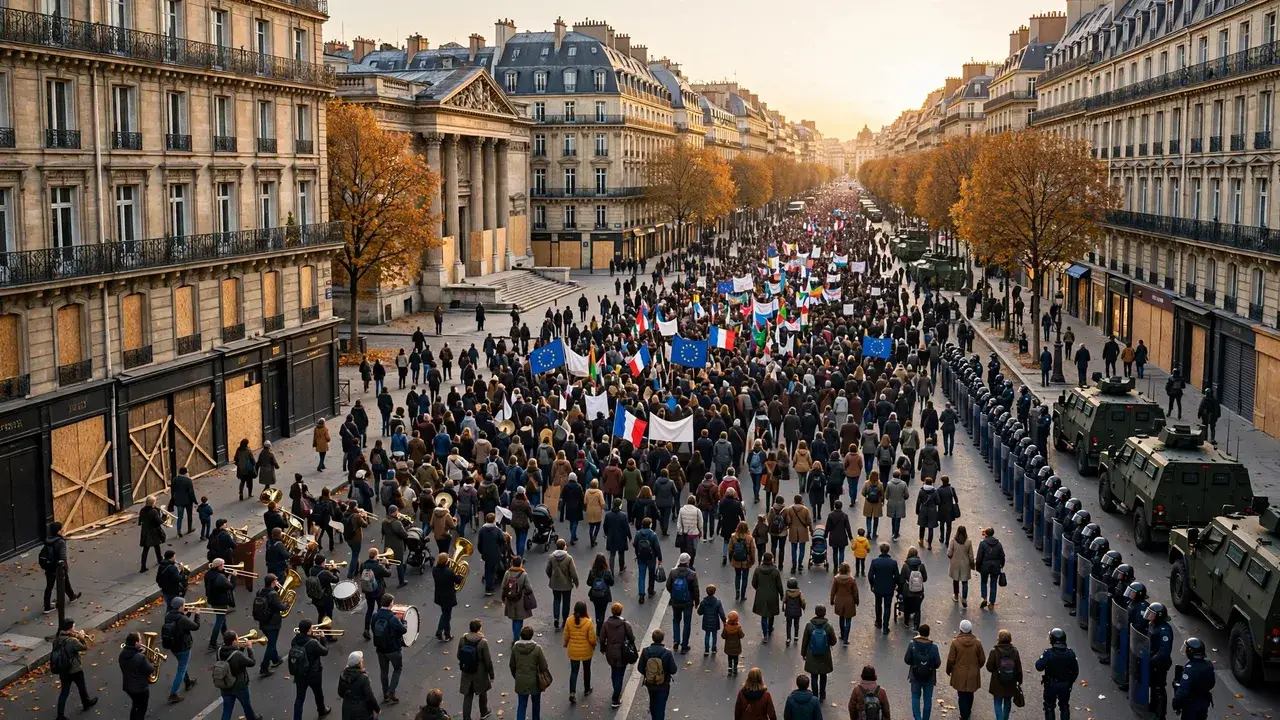
The second Saturday held. Hundreds of thousands of people marched across France on October 24, and the looting that tore through French cities a week earlier did not come back. The Interior Ministry counted 410,000 demonstrators nationwide, as of October 24. Unions put the figure at about 800,000. In Paris, police counted 110,000 marchers, and unions counted 250,000.
Picture is an illustration of a protest march on a Paris boulevard, with police lines watching from the side.
The Paris march ran along the eastern edge of the city, on the outer boulevard route the police prefecture imposed on Friday evening after moving it away from the Bastille to Nation path. Families walked in the main body of the march, and the crowd chanted against the cost of living and rising inequality. At the end of the route, near Porte de Vincennes, police fired tear gas and used water cannon against small groups of hooded youths who had thrown bottles and stones. The violence stayed far below the level of October 17.
Outside the capital, youths in Marseille dragged metal sheets across a street, set fire to rubbish bins and threw rocks and bottles at riot police, and the confrontations there ran on as night fell. Clashes also flared in Lyon, Bordeaux and Grenoble, and police fired volleys of tear gas in Clermont-Ferrand, Lille and Nice.
The arrests tell the story of the government method. Police ran preemptive searches before and during the marches. Interior Minister Laurent Nunez told reporters that 135 people had been arrested nationwide by early afternoon, many of them carrying fireworks, ball bearings and other items that could be used as weapons. By evening, Fox News reported that nearly 1,000 people had been arrested across the country, citing Nunez, and that officers in Paris had carried out more than 3,000 checks and arrested 65 people. Last weekend, by comparison, more than 2,700 people were arrested as protests turned into riots, and more than 3,000 businesses were damaged or looted across France, as of the official count.
Central Paris spent the day looking shut. Shopkeepers boarded their storefronts, business groups urged retailers to stay closed, the Louvre, the Musee d Orsay and the Paris Opera closed their doors, and more than 20 metro stations shut. “There are hardly any customers, so it is not really worth staying open,” said Oskar, the manager of a Kiton boutique in Paris.
The politics did not quiet down with the streets. Jean-Luc Melenchon, the hard left leader who joined the Paris march, called it a magnificent mass display of collective discipline and self restraint, and he warned President Emmanuel Macron that the marches will return every week until the government answers the anger behind them. “There is still time for him to give in. After that, the only thing left to him will be the exit door,” Melenchon said. The movement began last month with students protesting school conditions, teacher shortages and run down buildings, and it has widened into a general protest against living costs and inequality. Organizers have already called further protests for October 31.
Spotted an error in this story? Email [email protected] and it will be checked against the sources.