
Monday 19 October 2026
Canada names the four soldiers killed in the Wainwright fire, and the commander says the flames covered a kilometre in under a minute
The Canadian Armed Forces have named the four soldiers killed in the grass fire at Canadian Forces Base Wainwright on Saturday: Sergeant Morgan Wong of Edmonton, Private Shaun Farrell of Prince Albert, Private Aidan Goulding of North Vancouver and Private Hayden Lykkemark of Langley, all of the 3rd Battalion, Princess Patricia Canadian Light Infantry. Thirty nine people were injured, 19 of them critically, as of October 19. Major General Wade Rutland said officials had known about the fire for hours and believed it contained, before the wind shifted and the flames raced a kilometre in 30 to 60 seconds.
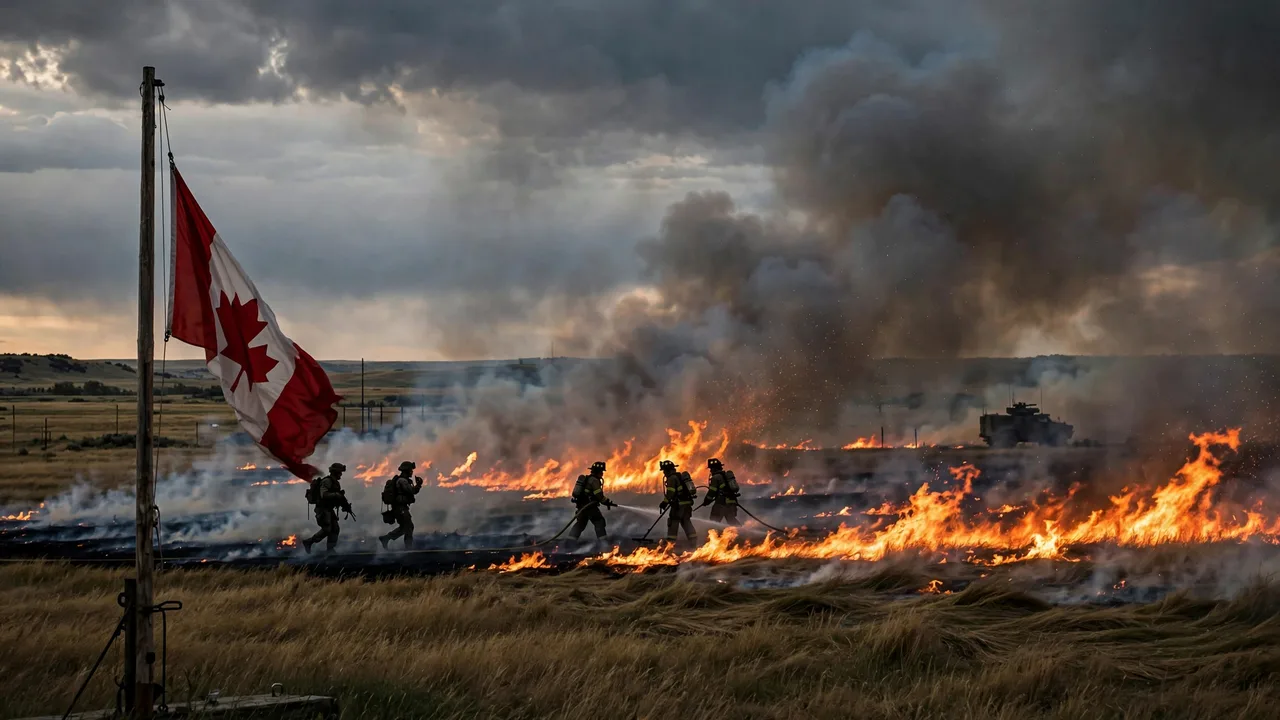
Canada has the names now, and it has the first account of how a fire the base was watching became a fire the base could not outrun. The four dead are Sergeant Morgan Wong of Edmonton, Private Shaun Farrell of Prince Albert in Saskatchewan, Private Aidan Goulding of North Vancouver and Private Hayden Lykkemark of Langley in British Columbia. All four served with the 3rd Battalion of Princess Patricia Canadian Light Infantry in Edmonton. Thirty nine people were taken to hospital, and 19 of them are in critical condition, as of October 19. Alberta Premier Danielle Smith said many of the injured will need weeks and months of specialized, intensive care.
Major General Wade Rutland, who commands the 1st Canadian Division, laid out the afternoon at a news conference in Edmonton on Sunday. Soldiers were in high intensity combat training with live munitions ahead of a deployment to Latvia. Some were throwing hand grenades at a grenade range while others ran a section attack, ten soldiers against a simulated enemy. A multitude of ordnance was moving through the training area, Rutland said: a grenade launcher, grenades, small arms and ammunition. A grass fire had ignited about a kilometre away. Its cause is still unknown. Quite frankly, it could have been any of that or none of it, he said.
The part of the account that will follow this investigation is the hours before the turn. Officials at the base had known about the fire for several hours and believed it sufficiently contained to let training continue. Winds had been below 50 kilometres an hour. Then the wind shifted and gusted to 96 kilometres an hour, 60 miles an hour, and the fire crossed the kilometre between it and the soldiers in 30 to 60 seconds. The fire was a kilometre away when the wind shifted, Rutland said. That is not normal for a fire to move a kilometre in 36 seconds. A commander at the scene told him the soldiers went from seeing no fire to having flames upon them in less than a minute. I have certainly never seen anything like it, Rutland said.
Prime Minister Mark Carney called it one of the worst peacetime tragedies for the Canadian Armed Forces on Canadian soil, said the nation is in mourning, and ordered flags on federal buildings lowered to half staff. The Department of National Defence said there is no indication the fire was tied to terrorist activity. Rutland promised a full Armed Forces investigation and warned against expecting it quickly. I will be candid, he said. With this number of casualties and the complexities involved, it will take neither a day nor a week. Fire and rescue crews remain at the base watching for flare ups.
The picture with this story is an illustration, not a photograph.
Spotted an error in this story? Email [email protected] and it will be checked against the sources.