
Country · Lithuania
Lithuania
1991–
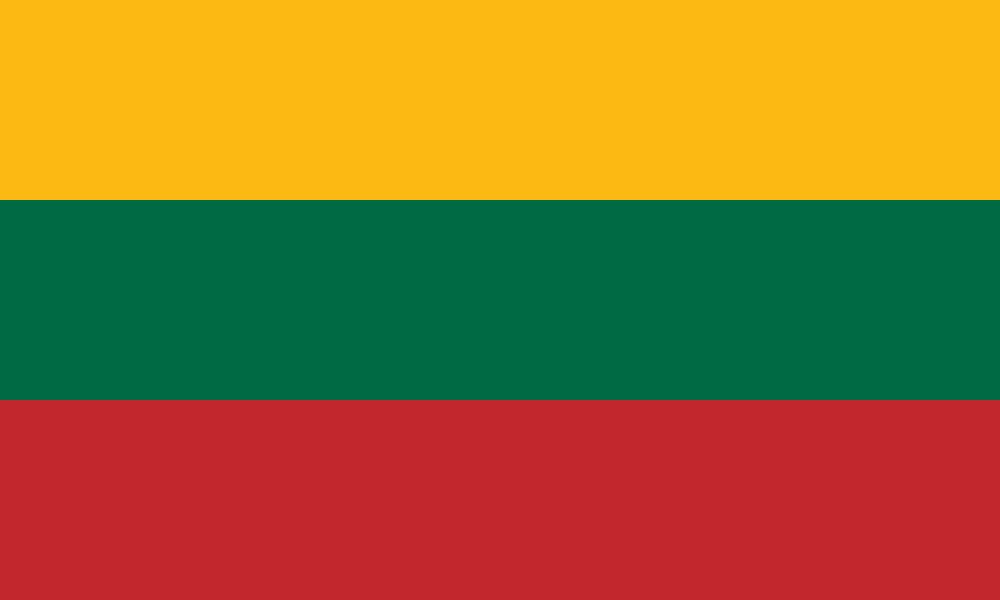
Lithuania is the largest of the Baltic states. Its medieval grand duchy was once the largest state in Europe. It was independent from 1918 to 1940, then under Soviet rule until independence was restored in 1991.
Lithuania is the southernmost and largest of the Baltic states, and Vilnius is its capital. The population is about 2.8 million (2024 estimate). Lithuanian is the official language, and Polish and Russian are spoken by long established minorities. Lithuania is a semi-presidential republic, with a directly elected president as head of state and a parliament, the Seimas, holding legislative power.
Mindaugas was crowned king of a united Lithuanian state in 1253. Under Grand Duke Gediminas, who founded Vilnius in 1323, and his successors, the Grand Duchy of Lithuania expanded across what is now Belarus and Ukraine to the Black Sea, and under Vytautas it stood at its greatest extent. Lithuanian and Polish forces defeated the Teutonic Knights at Grunwald in 1410. The Union of Lublin in 1569 merged the grand duchy with Poland in the Polish-Lithuanian Commonwealth. Russia, Prussia, and Austria partitioned the Commonwealth in 1772, 1793, and 1795, and the Lithuanian lands passed to the Russian Empire.
Lithuania declared independence on 16 February 1918. The Soviet Union annexed it in 1940 under the German-Soviet pact, Germany occupied it from 1941 to 1944, and Soviet rule then returned. Armed Lithuanian partisans fought the Soviets into the early 1950s. On 11 March 1990 Lithuania became the first Soviet republic to declare its independence restored. Lithuania joined the European Union and NATO in 2004 and adopted the euro in 2015.
Facts
- Founded
- 11 March 1990, independence restored; first independent 1918 to 1940.
- Source: CIA World Factbook
- Capital
- Vilnius.
- Source: CIA World Factbook
- Major rulers
- Gediminas, founder of Vilnius in the fourteenth century; Vytautas the Great, who led the grand duchy at its height.
- Source: Encyclopaedia Britannica, Lithuania
- Government
- Parliamentary republic.
- Source: CIA World Factbook
Sources
Source links accessed 22 November 2026.
Images
What happened elsewhere
Pairings are by recorded year, not exact simultaneity.
Meanwhile
Meanwhile, around the world — drag to spin, click a pulsing marker.
Keep reading
Test yourself
What was the capital?
- Vilnius
- Plymouth is the official capital but stands abandoned; government offices sit at Brades
- Lima
- Marigot
Answer
Vilnius — Capital: Vilnius.
When was Lithuania founded?
- 11 March 1990, independence restored; first independent 1918 to 1940
- 1918, as a republic after the fall of Austria Hungary; full sovereignty restored by the State Treaty of 1955
- 22 September 1908, full independence proclaimed; autonomy won in 1878
- 1956, independence from France and Spain; the Alaouite dynasty has ruled since the seventeenth century
Answer
11 March 1990, independence restored; first independent 1918 to 1940 — Founded: 11 March 1990, independence restored; first independent 1918 to 1940.
What form of government does Lithuania have?
- Parliamentary republic
- Presidential republic under long authoritarian rule
- Parliamentary republic under long single party dominance
- Parliamentary republic; the Althing, founded in 930, is among the oldest parliaments in the world
Answer
Parliamentary republic — Government: Parliamentary republic.
True or false: Lithuania is the largest of the Baltic states.
- True
- False
Answer
True — True. Lithuania is the largest of the Baltic states.
My notes
Highlights on this page
None yet.
Spotted an error on this page? Email [email protected] and it will be checked against the sources.