
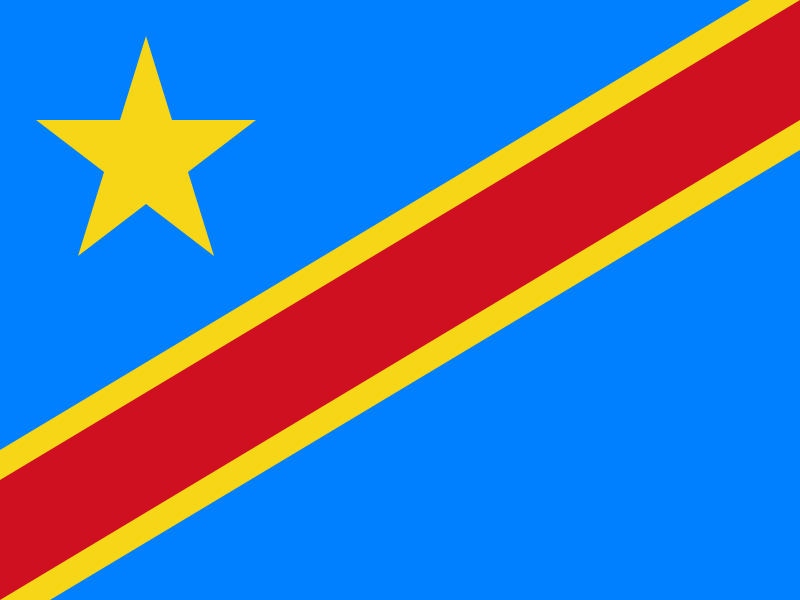
Country · Democratic Republic of the Congo
Democratic Republic of the Congo
1960–
The Democratic Republic of the Congo is the second largest country in Africa, immensely rich in minerals. Belgium ruled it brutally as a colony until independence in 1960. It is a semi presidential republic scarred by decades of war.
Kinshasa is the capital of the Democratic Republic of the Congo, the second largest country in Africa. The state is a semi presidential republic. French is the official language, and Lingala, Swahili, Tshiluba, and Kikongo hold national status. The population is about 108 million (2024 estimate).
Kingdoms including Kongo, Luba, and Lunda governed parts of the region before Europeans arrived. King Leopold II of Belgium claimed the Congo basin in 1885 and ruled it as his personal property, the Congo Free State. His agents forced Congolese to gather rubber and ivory under threat of violence, and historians estimate the deaths under that regime at between about one million and about fifteen million. Belgium took the colony from Leopold in 1908 and governed it as the Belgian Congo.
Independence came on 30 June 1960. The army mutinied within days, Katanga province seceded, and Prime Minister Patrice Lumumba was murdered in January 1961. Joseph Mobutu seized power in 1965, renamed the country Zaire in 1971, and ruled until rebels backed by Rwanda and Uganda drove him out in 1997. War from 1996 to 1997 and a second war from 1998 to 2003 drew in neighboring states, and surveys estimated several million excess deaths, most from hunger and disease. Armed groups still fight in the eastern provinces.
Facts
- Founded
- 30 June 1960, independence from Belgium.
- Source: CIA World Factbook
- Capital
- Kinshasa.
- Source: CIA World Factbook
- Major rulers
- Patrice Lumumba, the independence hero assassinated in 1961; Mobutu Sese Seko, dictator from 1965 to 1997.
- Source: Encyclopaedia Britannica, Democratic Republic of the Congo
- Government
- Semi presidential republic.
- Source: CIA World Factbook
Sources
Source links accessed 22 November 2026.
Images
What happened elsewhere
Pairings are by recorded year, not exact simultaneity.
- CyprusWhile Democratic Republic of the Congo (1960)
- BeninWhile Democratic Republic of the Congo (1960)
- Burkina FasoWhile Democratic Republic of the Congo (1960)
- CameroonWhile Democratic Republic of the Congo (1960)
- Central African RepublicWhile Democratic Republic of the Congo (1960)
Meanwhile
Meanwhile, around the world — drag to spin, click a pulsing marker.
Keep reading
Test yourself
What was the capital?
- Kinshasa
- São Tomé
- Skopje
- Kabul
Answer
Kinshasa — Capital: Kinshasa.
When was Democratic Republic of the Congo founded?
- 30 June 1960, independence from Belgium
- 17 April 1946, independence from France
- 20 August 1960, independence from France
- 27 June 1977, independence from France
Answer
30 June 1960, independence from Belgium — Founded: 30 June 1960, independence from Belgium.
What form of government does Democratic Republic of the Congo have?
- Semi presidential republic
- Federal parliamentary republic, permanently neutral
- Parliamentary republic
- The Palestinian Authority administers parts of the West Bank; Hamas has controlled Gaza since 2007
Answer
Semi presidential republic — Government: Semi presidential republic.
True or false: The Democratic Republic of the Congo is the second largest country in Africa, immensely rich in minerals.
- True
- False
Answer
True — True. The Democratic Republic of the Congo is the second largest country in Africa, immensely rich in minerals.
My notes
Highlights on this page
None yet.
Spotted an error on this page? Email [email protected] and it will be checked against the sources.