

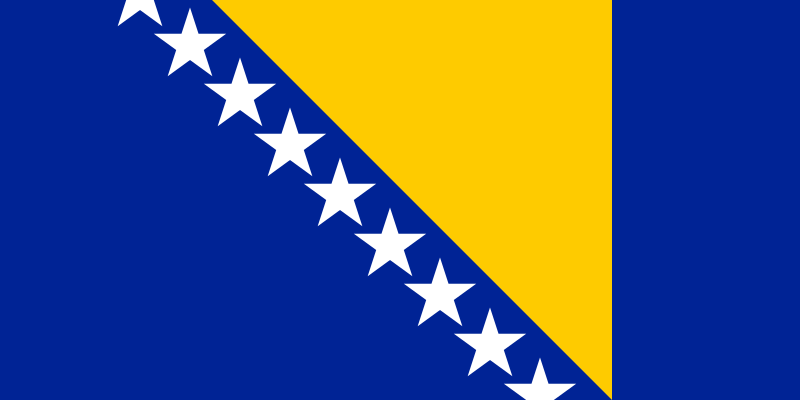
Country · Bosnia and Herzegovina
Bosnia and Herzegovina
1992–
Bosnia and Herzegovina is a Balkan country that declared independence from Yugoslavia in 1992. The declaration was followed by a three year war that ended with the Dayton Agreement of 1995. It is a federation of two entities sharing a three member presidency.
Sarajevo is the capital of Bosnia and Herzegovina, a federal republic in the Balkans. Bosnian, Croatian, and Serbian are the official languages, and about 3.2 million people lived in the country in 2024 estimates. Bosniaks, Serbs, and Croats are the three constituent peoples named in the constitution.
Bosnia formed a medieval kingdom before the Ottoman Empire conquered it in the fifteenth century, and many inhabitants converted to Islam under Ottoman rule. Austria Hungary occupied the province in 1878 and annexed it in 1908. A Bosnian Serb student shot Archduke Franz Ferdinand in Sarajevo in June 1914, a killing that set off the First World War. Bosnia belonged to Yugoslavia from 1918 to 1992, first in a kingdom and after 1945 as a republic in the socialist federation.
A referendum in early 1992 backed independence, and war began that April as Bosnian Serb forces, supported from Belgrade, seized large areas. The war killed about 100,000 people and drove about half the population from their homes. It included the siege of Sarajevo and the killing of about 8,000 Bosniak men and boys at Srebrenica in 1995. The Dayton Agreement of December 1995 ended the war and split the state into two entities, the Federation of Bosnia and Herzegovina and Republika Srpska. A three member presidency, one member for each constituent people, serves as head of state.
Facts
- Founded
- 3 March 1992, independence declared after a referendum; recognized in April 1992.
- Source: CIA World Factbook
- Capital
- Sarajevo.
- Source: CIA World Factbook
- Major rulers
- Alija Izetbegović, the first president, who led the country through the war of 1992 to 1995.
- Source: Encyclopaedia Britannica, Bosnia and Herzegovina
- Government
- Federal parliamentary republic with a rotating three member presidency.
- Source: CIA World Factbook
Sources
Source links accessed 22 November 2026.
Images
What happened elsewhere
Pairings are by recorded year, not exact simultaneity.
Meanwhile
Meanwhile, around the world — drag to spin, click a pulsing marker.
Keep reading
Test yourself
What was the capital?
- Sarajevo
- Managua
- Bangkok
- Phnom Penh
Answer
Sarajevo — Capital: Sarajevo.
When was Bosnia and Herzegovina founded?
- 3 March 1992, independence declared after a referendum; recognized in April 1992
- 15 August 1960, independence from France
- 12 October 1968, independence from Spain
- 12 July 1975, independence from Portugal
Answer
3 March 1992, independence declared after a referendum; recognized in April 1992 — Founded: 3 March 1992, independence declared after a referendum; recognized in April 1992.
What form of government does Bosnia and Herzegovina have?
- Federal parliamentary republic with a rotating three member presidency
- Presidential republic under dominant one man rule
- Parliamentary republic under long single party dominance
- Presidential republic, closely tied to Russia
Answer
Federal parliamentary republic with a rotating three member presidency — Government: Federal parliamentary republic with a rotating three member presidency.
True or false: Bosnia and Herzegovina is a Balkan country that declared independence from Yugoslavia in 1992.
- True
- False
Answer
True — True. Bosnia and Herzegovina is a Balkan country that declared independence from Yugoslavia in 1992.
My notes
Highlights on this page
None yet.
Spotted an error on this page? Email [email protected] and it will be checked against the sources.