
Country · Bolivia
Bolivia
1825–
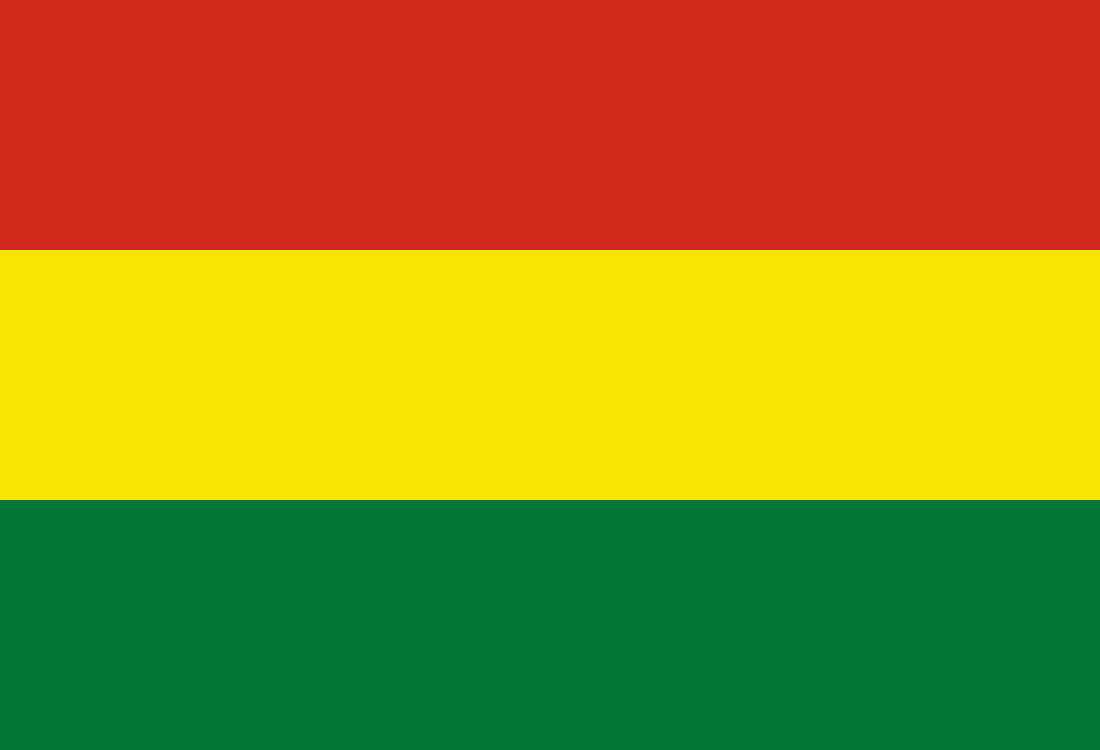
Bolivia is a landlocked country in central South America, named for Simón Bolívar. It declared independence from Spain in 1825. Its silver mines once funded the Spanish Empire; it is now a presidential republic.
Sucre is the constitutional capital of Bolivia, and the seat of government is La Paz, the highest capital city in the world. Bolivia is a landlocked presidential republic in central South America. The population is about 11.3 million (2024 census). Spanish and thirty six Indigenous languages are official, and Quechua, Aymara, and Guaraní are the most widely spoken Indigenous languages.
The Tiwanaku state stood near Lake Titicaca a thousand years ago, and the Inca Empire later ruled the highlands. Spanish conquerors took the region in the 1530s and called it Upper Peru. Silver from the mountain at Potosí, discovered in 1545, funded the Spanish Empire, and Indigenous laborers died in large numbers in the mines. Bolivia declared independence from Spain on 6 August 1825 and took its name from the liberator Simón Bolívar. The country lost territory in wars with its neighbors, including its coastline to Chile in the War of the Pacific, settled in 1904, and much of the Chaco lowland to Paraguay in the Chaco War of 1932 to 1935. A revolution in 1952 brought universal suffrage, land reform, and state control of the tin mines. Military governments ruled for much of the period from 1964 to 1982. Evo Morales, an Aymara coca growers' leader, served as president from 2006 to 2019 and resigned under military pressure after a disputed election.
Facts
- Founded
- 6 August 1825, independence declared; named for Simón Bolívar.
- Source: CIA World Factbook
- Capital
- Sucre and La Paz share capital functions.
- Source: CIA World Factbook
- Major rulers
- Simón Bolívar, the liberator; Evo Morales, the first indigenous president, from 2006 to 2019.
- Source: Encyclopaedia Britannica, Bolivia
- Government
- Presidential republic.
- Source: CIA World Factbook
Sources
Source links accessed 22 November 2026.
Images
What happened elsewhere
Pairings are by recorded year, not exact simultaneity.
- BrazilWhile Bolivia (1822)
- UruguayWhile Bolivia (1828)
- Costa RicaWhile Bolivia (1821)
- MexicoWhile Bolivia (1821)
- PeruWhile Bolivia (1821)
Meanwhile
Meanwhile, around the world — drag to spin, click a pulsing marker.
Keep reading
Test yourself
What was the capital?
- Sucre and La Paz share capital functions
- Bishkek
- Andorra la Vella
- Amsterdam; the seat of government is The Hague
Answer
Sucre and La Paz share capital functions — Capital: Sucre and La Paz share capital functions.
When was Bolivia founded?
- 6 August 1825, independence declared; named for Simón Bolívar
- 27 October 1979, independence from Britain
- 21 September 1991, independence declared as the Soviet Union dissolved
- 1 July 1962, independence from Belgium
Answer
6 August 1825, independence declared; named for Simón Bolívar — Founded: 6 August 1825, independence declared; named for Simón Bolívar.
What form of government does Bolivia have?
- Presidential republic
- Presidential republic; the island is divided, with the north administered by Turkish Cypriots since 1974
- A territorial council and its president govern local affairs; a prefect represents the French state
- Semi presidential republic; chronic coups
Answer
Presidential republic — Government: Presidential republic.
True or false: Bolivia is a landlocked country in central South America, named for Simón Bolívar.
- True
- False
Answer
True — True. Bolivia is a landlocked country in central South America, named for Simón Bolívar.
My notes
Highlights on this page
None yet.
Spotted an error on this page? Email [email protected] and it will be checked against the sources.