
Artifacts · No. 47
Stephenson's Rocket
The locomotive that won the Rainhill Trials and set the pattern for every steam engine after it: the multi tube boiler and the blast pipe in one small yellow machine.
1829Zoomable photographFamily viewing: YesCatalogue: 1862-5
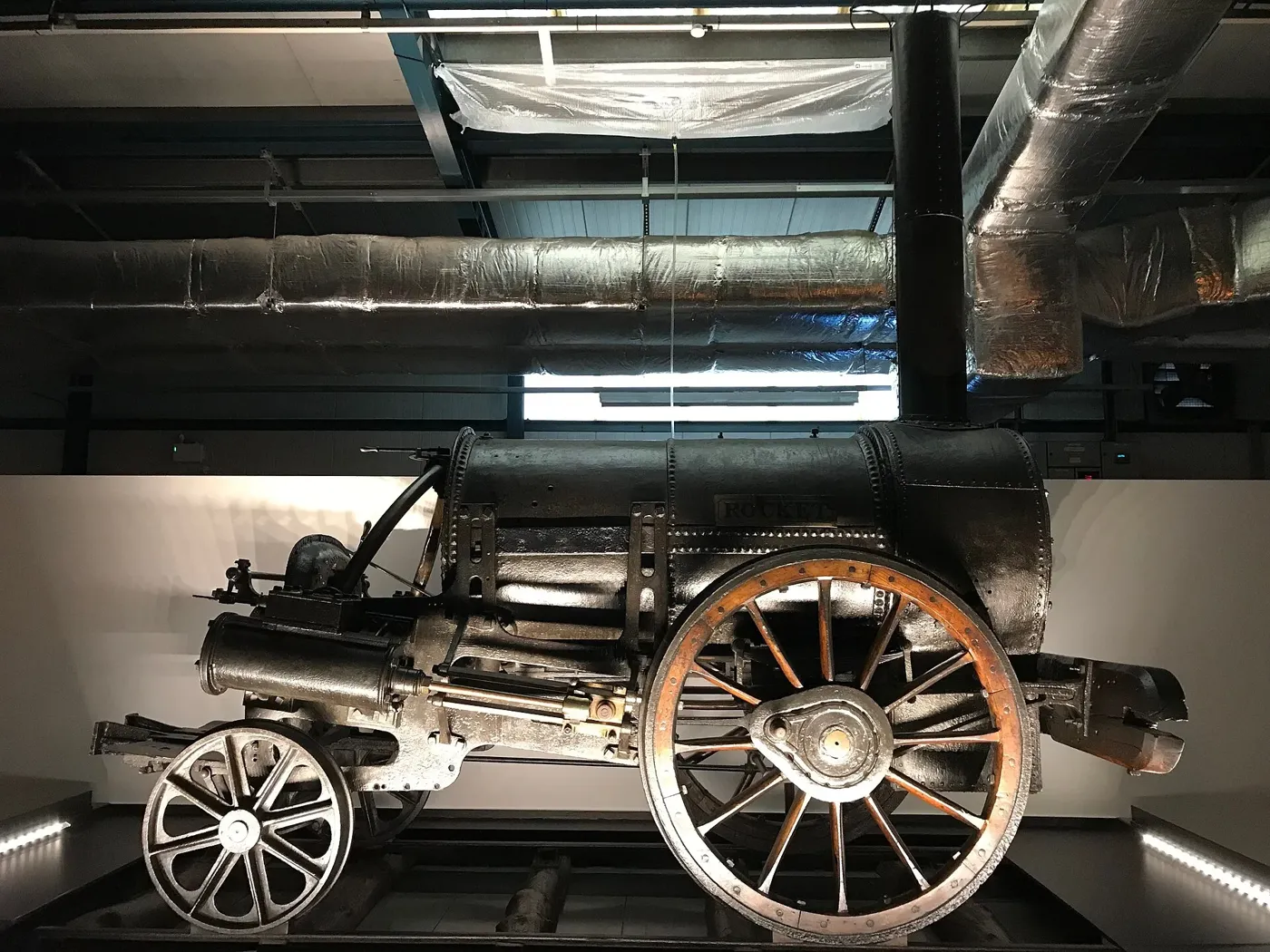
Photograph: Matt Brown · CC BY 2.0 · Source · Our own reconstruction programme covers this page with a photograph: the Science Museum Group scan is non commercial licensed and is linked, not embedded, and no procedural model of a locomotive could match the scan's fidelity.
Held by: National Railway Museum, York (Science Museum Group) · Catalogue 1862-5
The museum's own scan. This object's published 3D scan is under a non commercial license, so it is not embedded here. Science Museum Group: the Rocket LiDAR scan (Sketchfab, CC BY-NC)
The story
The Liverpool and Manchester Railway offered £500 at Rainhill in October 1829 for a locomotive that could haul its load at speed. Robert Stephenson and Company's Rocket, built in Newcastle in a matter of weeks, won outright: a multi tubular boiler that made steam fast, a blast pipe that used the exhaust to draw the fire, and a single pair of driving wheels. It reached 30 miles an hour and finished its runs when its rivals broke or, in the case of the Novelty, burst.
Rocket worked a few years, was altered, and ended as a relic early: patented, exhibited, and given to the Patent Museum in 1862, which is why it survives at all. The Science Museum Group's LiDAR scan of it is published under a non commercial license, so this site does not embed it. This page carries a zoomable photograph and links the Group's own scan; the locomotive as it stands today differs from its 1829 self, and the photograph shows the altered survivor.
The record, not the myth
Rocket was not the first steam locomotive, nor even the Stephensons' first: its claim is the synthesis, the features combined that every later engine kept. Its present form includes later alterations, and purists argue over how much of 1829 is left in it.
Sources
Image and model credits
- PhotographMatt Brown · CC BY 2.0 · Source