
Artifacts · No. X10
Shroud of Turin
A linen cloth bearing the faint image of a crucified man, venerated as the burial shroud of Christ and dated by radiocarbon to the Middle Ages: the most studied cloth in the world.
Radiocarbon dated 1260-1390 (1988)Zoomable imageFamily viewing: No
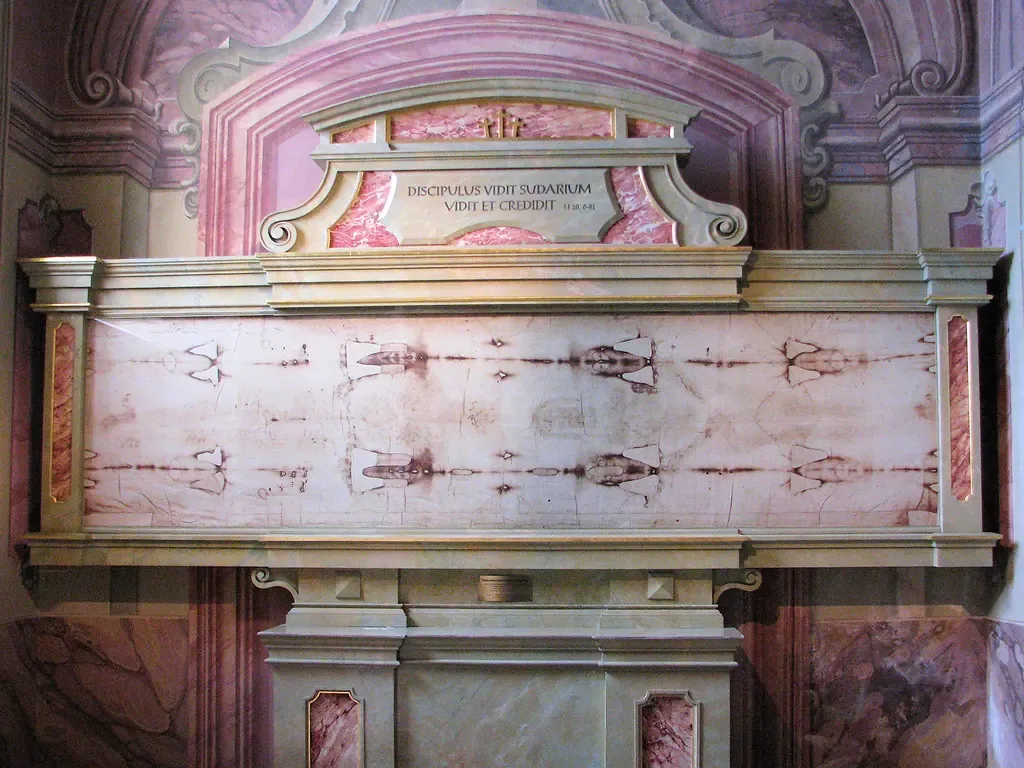
Image: Krzysztof D. · CC BY 2.0 · Source
Held by: Turin Cathedral (Chapel of the Holy Shroud)
Seeing it. As of November 2026 the Shroud is not on public view; it is kept in the Chapel of the Holy Shroud and shown only at announced ostensions.
The story
The cloth is 4.4 metres of linen in a herringbone weave, bearing the front and back image of a naked man with the wounds of a crucifixion, and darker bloodstains. It is documented in France in the 1350s, at Lirey, where the local bishop's memorandum later said the image was a painting whose artist had confessed; it passed to the House of Savoy, was burned and repaired in 1532, and came to Turin in 1578. The Church, which owns it, presents it as an object of veneration and does not rule on its authenticity.
In 1988 three laboratories radiocarbon dated a single sample strip and returned 1260 to 1390 with high confidence, the result the scientific record stands on. Challenges since have aimed at the sample, arguing it came from a medieval repair patch; re-examinations of the data and the cloth continue, and the argument is genuinely not closed in the journals, though the 1988 date remains the reference point. The cloth is not on public view and is shown only at rare ostensions, most recently in 2015.
The record, not the myth
The 1988 radiocarbon range is the measured fact; the patch challenge is a live dispute about sampling, not a new date. No mechanism for the image's formation commands a consensus, which is a statement about the image, not evidence for any one account of it.
Sources
Image and model credits
- PhotographKrzysztof D. · CC BY 2.0 · Source