
Artifacts · No. X6
Magna Carta (1215)
The great charter sealed by King John at Runnymede: the document that put into writing the claim that the king is under the law, and the ancestor of due process.
1215Zoomable imageFamily viewing: Yes
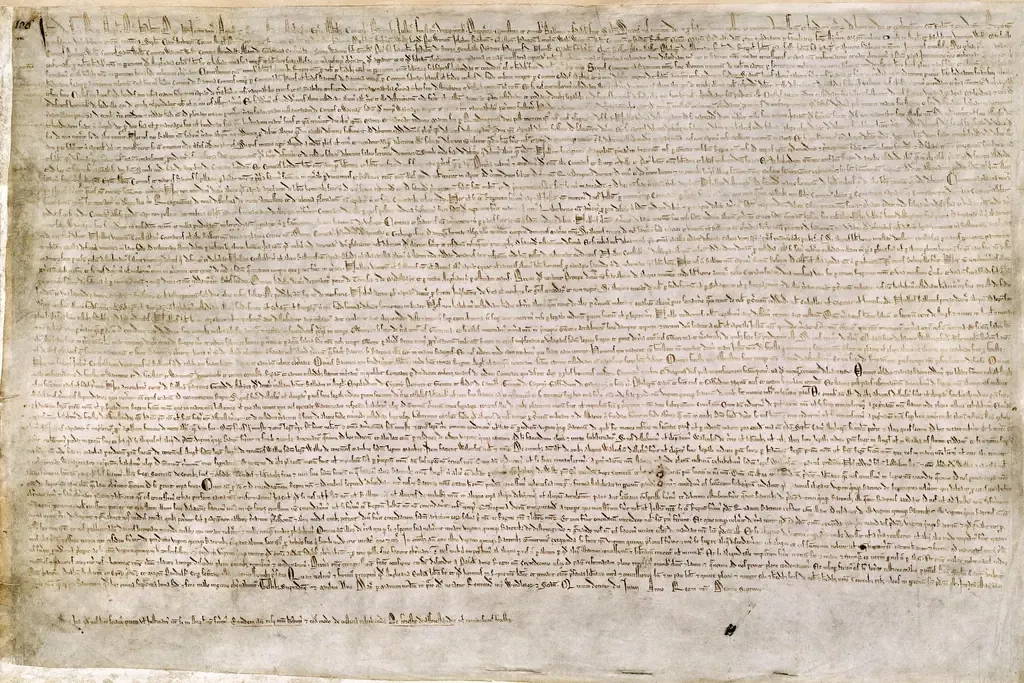
Image: Unknown creator · CC0 1.0 · Source
Held by: Four exemplifications: British Library (2), Lincoln Castle, Salisbury Cathedral
The story
In June 1215, beaten in France and facing his barons in arms, King John sealed the charter his opponents had drafted: 63 clauses of feudal grievance, church rights, town privileges, standard measures, and, at clauses 39 and 40, the lines that outlived the rest, that no free man is to be taken, imprisoned or disseised except by the lawful judgement of his peers or the law of the land, and that right and justice are not to be sold, denied or delayed.
John had it annulled within weeks and died in a civil war the next year; his son's governments reissued it, in shorter forms, in 1216, 1217 and 1225, and it entered the statute book. Four copies of the 1215 original survive: two at the British Library, one at Lincoln Castle, one at Salisbury. The Lincoln copy's page is linked here; the British Library's famous Cotton Augustus II.106 is its twin.
Clause 39, in translation
“No free man shall be seized or imprisoned, or stripped of his rights or possessions, or outlawed or exiled, or deprived of his standing in any other way, nor will we proceed with force against him, or send others to do so, except by the lawful judgement of his equals or by the law of the land.”
Clause 40 follows: To no one will we sell, to no one deny or delay right or justice.
The record, not the myth
Magna Carta protected free men, a minority of the population in 1215, and most of its clauses are feudal housekeeping long repealed; three clauses remain in force in English law. Its career as a universal liberty text is a later, mostly seventeenth century, rereading, which is itself part of the record.
Sources
Image and model credits
- PhotographUnknown creator · CC0 1.0 · Source