
Artifacts · No. 75
Enigma Machine
The cipher machine whose breaking shortened the Second World War: three rotors, a plugboard, and a daily key, beaten at Bletchley Park by mathematics, captured material and Polish groundwork.
c. 1930s-1940sZoomable photographFamily viewing: YesCatalogue: 1980-1200
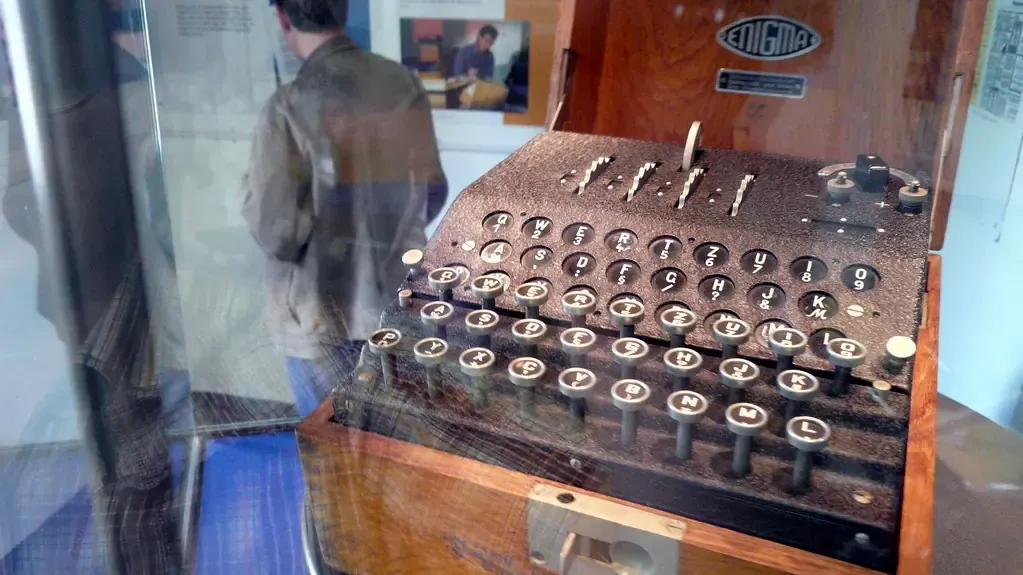
Photograph: gruntzooki · CC BY-SA 2.0 · Source · The Science Museum's scan is non commercial licensed, so it is linked, not embedded.
Held by: Science Museum, London · Catalogue 1980-1200
The museum's own scan. This object's published 3D scan is under a non commercial license, so it is not embedded here. Science Museum Group: the Enigma scan (Sketchfab, CC BY-NC-SA)
The story
The Enigma was a commercial cipher machine of the 1920s that the German armed forces adopted and hardened: a keyboard, three or five swappable rotors, a reflector that made the machine its own decoder, and a plugboard that multiplied the settings beyond any hand count. The German services trusted it with everything from weather reports to U boat dispositions.
It was broken anyway: first by Polish mathematicians in the 1930s, who read it and gave their work to Britain and France in 1939, then at Bletchley Park, where Alan Turing and Gordon Welchman's Bombe machines and the capture of key sheets from U boats kept the reading going through the war. The Science Museum's published scan of its Enigma is under a non commercial license, so it is not embedded here; this page carries a zoomable photograph and links the scan, and states the Polish priority plainly, as the record requires.
The record, not the myth
Bletchley did not win the war alone and its people said so; what Ultra did was shorten campaigns and save convoys, a measurable edge, not a magic one. The machine on this page is a museum example of the type, not a machine with a named battle history.
Sources
Image and model credits
- Photographgruntzooki · CC BY-SA 2.0 · Source